



Ace the toughest MBA exam with the power of community. Tackle decision-making dilemmas, conquer essa...

3 hours ago
Body
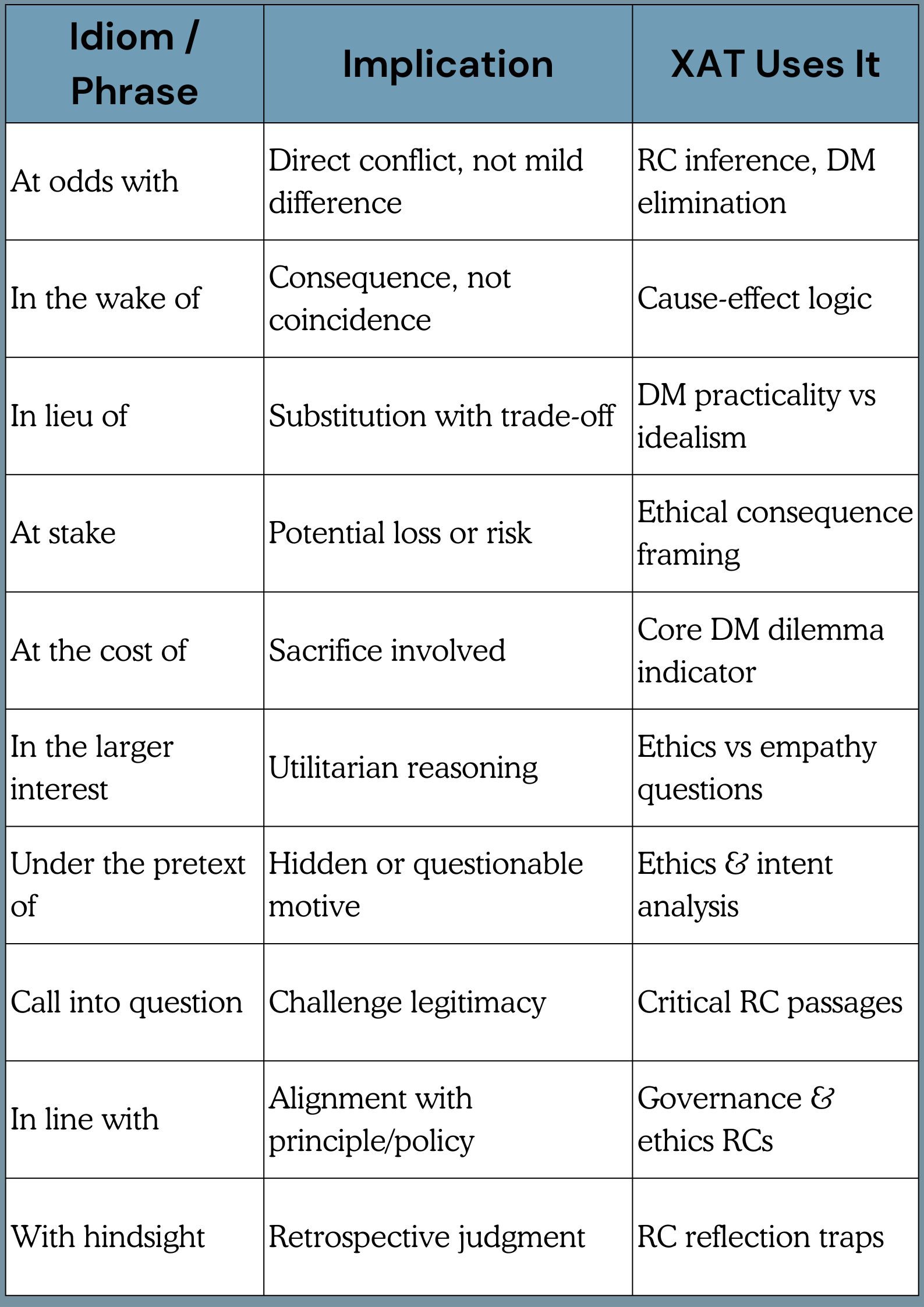
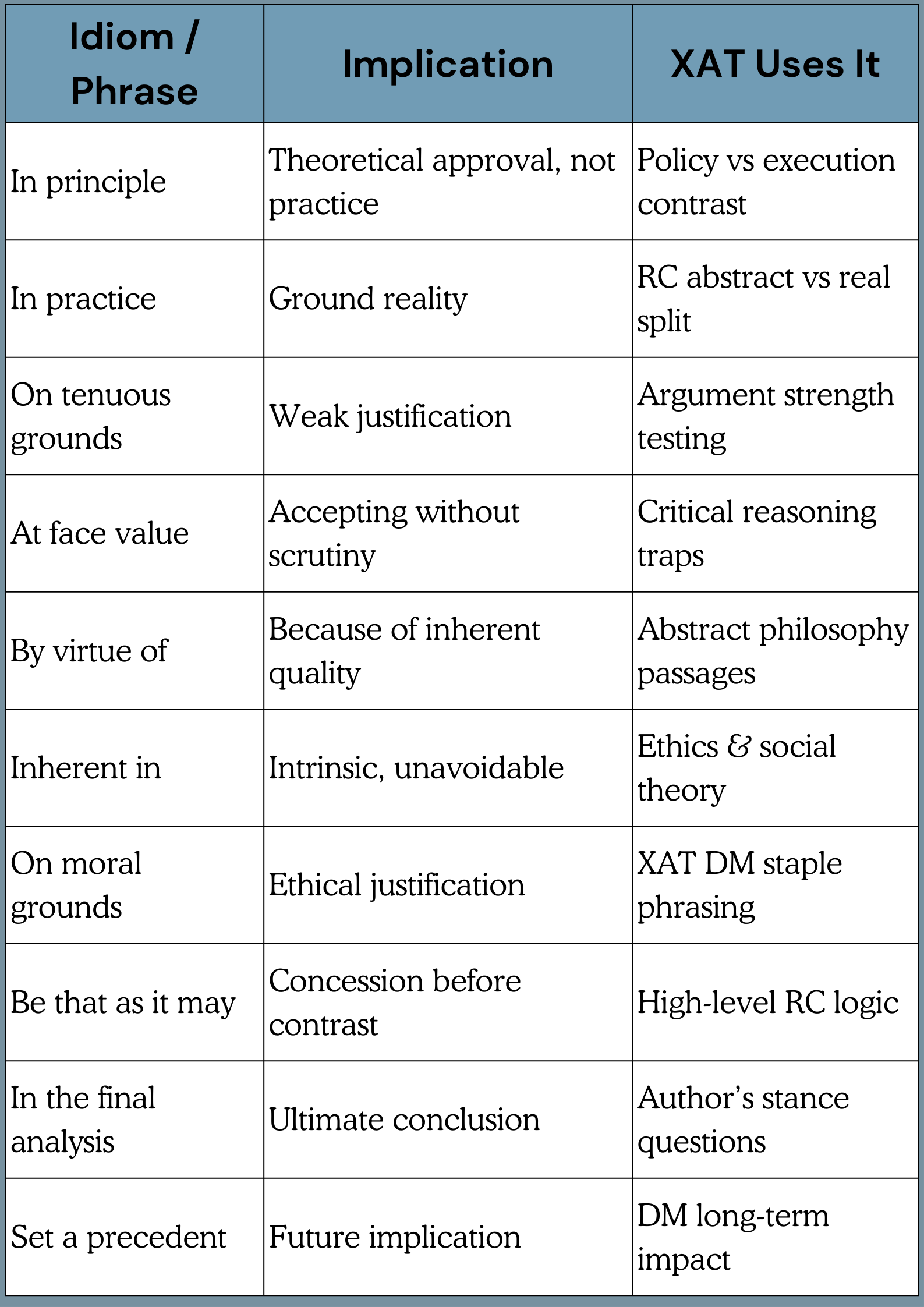
If you look closely at XAT RC and DM papers over the years, a clear pattern emerges. The hardest options are rarely factually incorrect. Instead, they are linguistically precise but logically misleading. The phrases highlighted in the table are not tested as vocabulary. They are used as reasoning triggers devices that subtly change how a situation should be evaluated.
These Phrases Carry Ethical and Philosophical Weight
Many of these expressions in the larger interest, on moral grounds, at stake, set a precedent are value laden. They shift the nature of a decision from a factual evaluation to a normative judgment.
XAT repeatedly checks whether students:
-
Accept moral language without examining consequences
-
Justify harm by appealing to collective benefit
-
Confuse ethical intent with ethical outcome
An option that sounds morally elevated is often more dangerous than one that sounds plain.
Trade-Off Language Is a Signal, Not a Detail
Phrases such as in lieu of, at the cost of, be that as it may explicitly indicate sacrifice. XAT uses them to test whether you recognize that a choice involves giving something up and whether that sacrifice is necessary, justified, or premature.
In DM questions especially, these phrases force you to ask:
-
Is the trade-off unavoidable, or are alternatives ignored?
-
Is the cost proportional to the benefit?
-
Is the sacrifice imposed on the weakest stakeholder?
Students often lose marks by treating these phrases as neutral connectors. They are not. They are warning labels.
Some Phrases Exist Solely to Expose Weak Reasoning
Expressions like on tenuous grounds, at face value, under the pretext of are evaluative. They question legitimacy, intent, or depth of justification. XAT uses them to test whether you are comfortable assigning intent or criticism only when the passage supports it.
A common error is choosing options that accuse actors of hidden motives without textual evidence. XAT is extremely strict about this. If the passage does not establish intent, such options are usually traps.
Author Stance Is Often Hidden in These Signals
Phrases such as call into question, be that as it may, in the final analysis are not fillers. They often mark turning points in argumentation concession, contrast, or conclusion.
In RC questions that ask for the author’s view, students often choose options that summarize facts or sound balanced. XAT instead rewards options that correctly reflect:
-
The author’s final judgment
-
The direction of criticism or support
-
The conclusion drawn after weighing arguments
Understanding these signals helps separate neutral narration from evaluative stance.
How to Use This Table During the Exam
Do not try to memorize meanings. That misses the point.
Instead, when you encounter these phrases, ask:
-
What logical commitment does this phrase force me to accept?
-
Is this option introducing a moral judgment, a trade off, or a conclusion?
-
Does that commitment match the passage or situation exactly?
If the implication overshoots the evidence, eliminate.