



4 months ago
Body
If you are going to study abroad, there is one requirement you cannot avoid: prove your English proficiency. And as for global acceptance, IELTS is still the most accepted exam in countries such as the UK, USA, Canada, Australia and New Zealand.
Millions of students take the IELTS every year. Not because they want to, but because it makes doors open. Universities use it. Visa authorities use it. Employers use it.
So, instead of making things complex, let’s simplify it in a way that actually helps you prepare and score well.
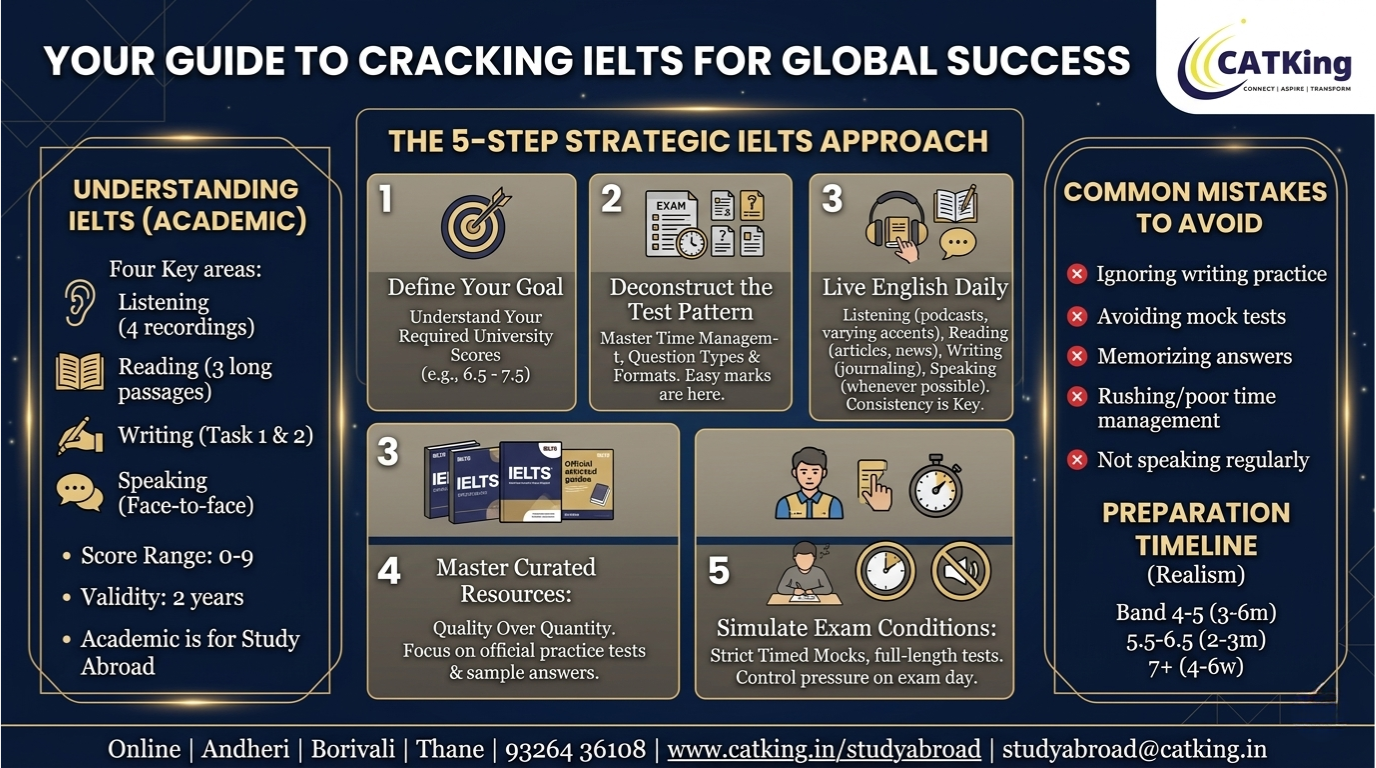
What is IELTS (and why it’s more important than you realise)
The bottom line is that IELTS only tests one thing:
Are you talking English?
It grades you on four things:
• Listening.
• Read More
• Writing
• Talk
You will be given a band score of 0 to 9 and your result is valid for 2 years.
Most universities expect:
• Overall: 6.5 to 7.5
• No section below 6.0
The real truth is, most students are not having problems because their English is bad.
They fail because they don’t know how the test really works.
Academic vs General IELTS (Don’t get it wrong)
Before you begin preparing, be clear about this:
• IELTS Academic → Study abroad
• IELTS General Training → For work, PR or migration
If you’re applying to universities, your test is academics. No mixup here.
What the IELTS test is really like
“Let’s clear up the mystery.
Listening (30 min)
You will hear 4 recordings, conversations and monologues.
Hearken well to the details, for you shall hear them but once.
Reading (60 min)
3 long passages, 40 questions.
This section is less about English and more about speed + accuracy under pressure.
Writing (1 hour)
• Task 1: Writing a description of a graph or chart (150 words)
• Task 2: Write an essay (250 words)
This is where most students lose marks, not for grammar but for structure and clarity.
Speaking (11-14 min.)
A face to face discussion with an examiner.
And it sounds like a conversation but they are judging softly:
• Fluency
• Self-confidence
• Clear thinking
The 5-Step IELTS Strategy That Works
Most students study either too much or randomly. Neither works.
Here is a clever way.
1. Begin with your goal score
Don’t say, “I want to do well.”
Be specific:
• What score do you need for your university
• Where are you?
For instance:
If you’re at a 5.5 and need a 7.0, your plan has to be structured.
If you are already at 6.5, you just need refinement.
2. Deep knowledge of the test pattern
This is where the easy points are made.
Many students lose points just because:
• They misunderstand questions
• They don’t know time management
• They do not know answer formats
Once you get the pattern down well, your score can really go up with very little improvement in your English.
3. Use English in your daily life
This is where the fun, and frankly the easy, prep comes in.
You don’t have to stay with the books all day. Just be exposed:
Listening.
• Podcasts, interviews, Netflix (with subtitles if needed)
• Try different accents.
Read More
• Articles, blogs, news
• Fast understanding, not perfect
Writing
• Start small. Daily journaling works.
• Move gradually to essays
Talk
• Speak English as much as possible
• Even talking to yourself helps more than you think.
Here consistency is better than long hours of study.
4. Better and more resources
What is a big mistake students make?
Too much stuff has accumulated and nothing is finished.
Please stick to:
• IELTS official practice tests
• Sample Responses
• Some Reliable Guides
It’s not the amount you study.
It’s not about how much you study; it’s about how well you understand.
5. Practice like the real test
This is the game-changer.
At some point you have to stop “preparing” and start simulating.
• Do full-length exams
• Timing is everything
• Eliminate distractions
On exam day you need control under pressure because knowledge at that point won’t help.
How long do you 'really' need?
Be truthful about your level:
• 3–6 months Band 4–5 →
• Band 5.5-6.5 → 2-3 months
• Band 7+ → 4-6 weeks
There is no set rule, but rushing never works.
Mistakes that silently destroy your score
They are more common than you think.
• Forgetting to write a
• not talking regularly.
• Memorising answers (this is counter-productive)
• not giving mock tests
• Lack of time management
Fix these and you are ahead of most test takers already.
Final thoughts
The IELTS is not a hard exam but a strategic one.
It seems hard to prepare randomly.
If you prepare smartly, it becomes predictable.
And once you break it, it’s not just a score; you’ve opened access to global opportunities.