


Crack the CAT, together. Welcome to the ultimate prep zone for CAT aspirants. From 99 percentilers s...

1 month ago
Body
Starting CAT preparation can be confusing. You search for how to start CAT preparation and suddenly you have hundreds of videos, books, study plans, mock tests and people telling you what you should be doing.
One person tells you to start with Quant. Someone else tells you to read for two hours every day. Then you find another video saying you should start taking mocks immediately. After a point, you spend more time planning your preparation than actually preparing.
So where do you actually begin.
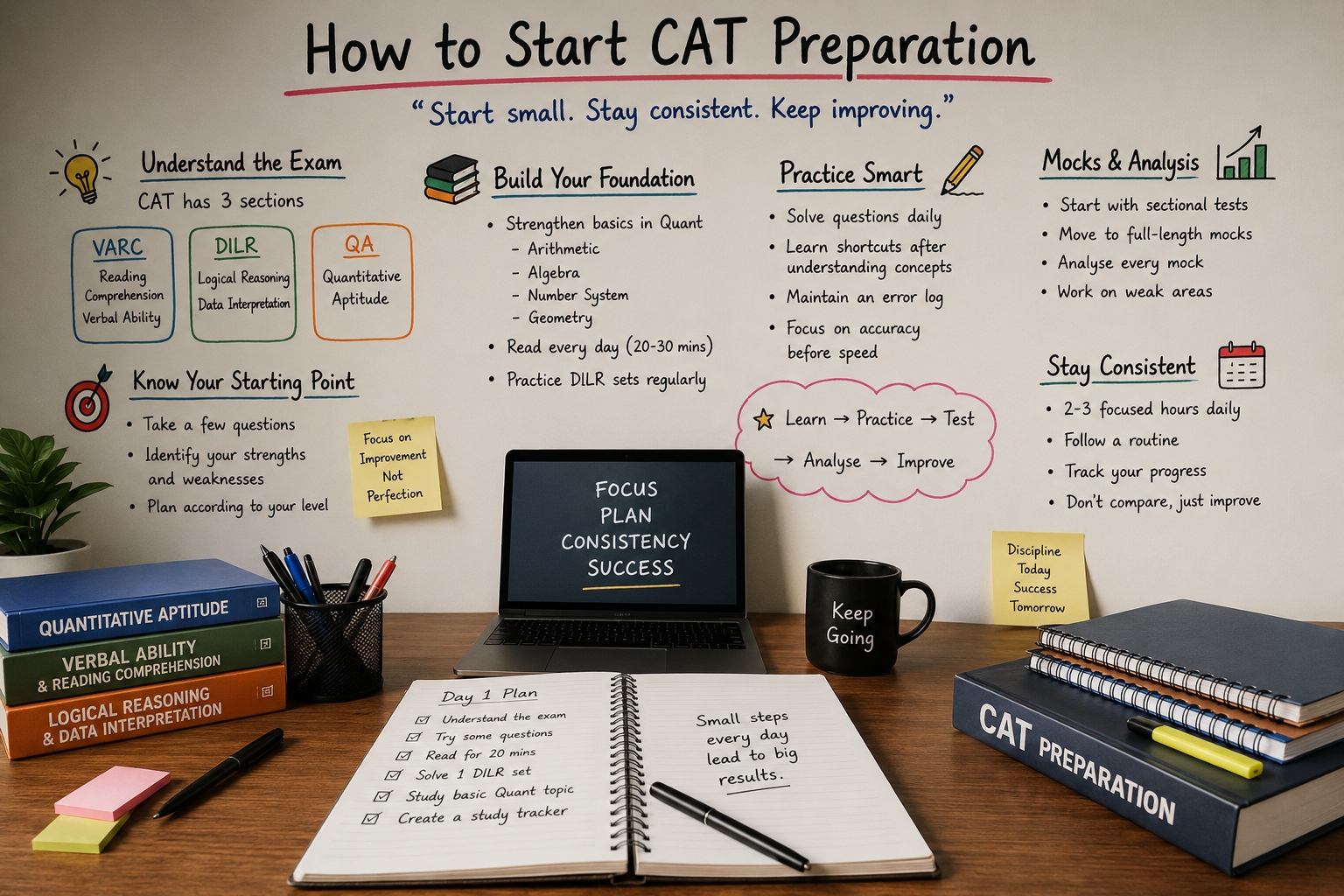
Start by understanding the exam. CAT has three sections, VARC, DILR and QA. Each one needs a slightly different approach. VARC is about reading and understanding what the author is saying. DILR tests how well you can make sense of information and find a way through a set. QA needs a good hold over mathematical concepts and the ability to apply them quickly.
Before you make a timetable, figure out where you stand. Take a few questions from each section and see what happens. You might find that Quant is comfortable but reading takes time. You might be good at VARC but struggle with DILR. Or you might realise that your maths basics need some work. That is useful information because your preparation should be based on your level, not somebody else’s schedule. CATKing also recommends understanding your starting point before deciding how to approach preparation.
If your maths is weak, go back to the basics. Percentages, ratios, averages, profit and loss, time and work, time speed distance and basic algebra are a good place to start. There is no shame in revisiting school level maths. In fact, it can save you a lot of frustration later because CAT questions become much easier when the basics are clear. CATKing’s preparation framework also places foundation building before speed and shortcuts.
At the same time, start reading every day. You do not need to sit with a newspaper for two hours. Even 20 to 30 minutes of serious reading is a good start. Read an editorial, an article about economics, science, history, philosophy or any subject that makes you think a little.
The important part is what you do after reading. Ask yourself what the author was trying to say. What was the main argument. Why did the author make that argument. What assumptions were being made. Could you explain the passage without going back to it.
This is where reading starts becoming CAT preparation instead of simply reading. CATKing’s beginner preparation material also places emphasis on reading and comprehension rather than treating vocabulary memorisation as the main way to prepare for VARC.
DILR is another section you should start early. Many students avoid it because there is no fixed formula that works for every set. That is exactly why regular practice matters. Start with manageable sets involving tables, arrangements, games, selections, distributions, schedules, graphs or caselets. At first, do not worry too much about finishing everything quickly. Try to understand how the information is organised and how you can approach the set.
With practice, you will start noticing patterns. You will also become better at deciding which sets are worth attempting and which ones are likely to consume too much time. CATKing’s preparation material talks about this kind of logical structuring and pattern recognition in DILR.
One thing I would strongly avoid is finishing one section completely before touching the others. You might think you will finish Quant first and then move to VARC, but that usually creates a problem later. Reading ability takes time to develop, and DILR also needs regular exposure.
You can keep your daily routine simple. Maybe you spend an hour on Quant, then 30 minutes reading and another 30 minutes on DILR. On another day you can spend more time on VARC and less on Quant. The exact schedule can change depending on college, work and your current level. What matters is that all three sections remain part of your week.
You also do not need to study for ten hours a day just because somebody on Instagram says they did. If you are starting out, two or three genuinely focused hours can be enough to build the habit. As you get closer to the exam, you can increase the time if required. Your actual concentration matters much more than the number written on your timetable. CATKing’s beginner guidance also suggests starting around two to three hours a day and increasing the intensity as preparation progresses.
Once you learn a concept, solve questions. This sounds obvious, but it is one of the easiest things to ignore. Watching someone solve Arithmetic on YouTube can make you feel like you understand Arithmetic. Then you sit down with a question and realise you cannot solve it without looking at the solution.
That is normal. Keep solving.
When you make a mistake, do not simply check the answer and move on. Try to understand why you got it wrong. Maybe you did not know the concept. Maybe you understood the concept but made a calculation error. Maybe the question was taking too long and you should have left it. These are very different problems, and they need different solutions.
Keep an error log if it helps. You can simply write down the question, what went wrong and what you should have done differently. After a few weeks, you will start seeing the same mistakes coming back. That is when the error log becomes really useful.
Shortcuts are useful too, but learn them after you understand the basic method. If you memorise a shortcut without understanding the idea behind it, you may know the trick but still not know when to use it. First understand the concept, then solve it normally, and only then look for faster methods.
The goal eventually is to look at a question and make a quick decision. Can I solve this. How long will it take. Is it worth attempting. That judgement becomes very important in CAT because you do not have unlimited time.
Mocks should become part of your preparation gradually. You do not need to wait until the entire syllabus is finished. Once you have covered enough basics, start with sectional tests and then move towards full length mocks.
But there is one thing that matters more than simply taking mocks, analysis. If you take a mock, see your percentile and immediately start another one, you are leaving out the part that can actually help you improve.
Suppose you made five mistakes in Quant because of calculation errors. That tells you something. Suppose you spent twelve minutes on a DILR set and got nowhere. That tells you something too. Maybe you attempted a difficult VARC question even though there were easier questions waiting elsewhere in the section. That is also something worth noticing.
Your mock score tells you where you are. Your analysis tells you why you are there. CATKing’s current preparation approach also puts significant importance on mocks, analysis, question selection, accuracy and time management.
There is another trap that has become very common because of YouTube and Instagram. You can spend an entire evening watching CAT videos and still feel like you have prepared.
You watch a video on how to score 99 percentile. Then one on the best CAT books. Then another on how toppers studied. Then you save a reel about the perfect daily routine. By the end of the evening, you have six new strategies and zero solved questions.
Use CATKing’s YouTube content when you need to learn a concept, understand a strategy, solve PYQs or analyse a mock. Instagram can be useful for quick tips, updates and short pieces of advice. Quora can help you understand the questions and concerns other CAT aspirants have. But do not let consuming preparation content become a replacement for preparation itself.
If you are starting from zero, keep the first few months fairly simple. Build your Quant basics, read regularly, practise DILR and get comfortable with the kind of questions CAT asks. Once the basics are in place, increase your question practice and introduce sectional tests. Later, your focus should shift more towards mocks, revision, time management and question selection.
Your preparation will also depend on how much time you have. Someone starting more than a year before CAT can afford to move slowly and build their basics properly. Someone with six months has to be more organised. Someone with three or four months needs to prioritise high impact topics and get into testing sooner. If you have around 100 days, you need to be selective about where you spend your time.
You also do not have to join coaching just because everyone around you is doing it. Self study can work. Books, previous year questions, online classes, YouTube, mocks and proper analysis can give you enough material to prepare. The harder part is staying accountable when nobody is checking whether you actually studied today.
If you are starting today, keep Day 1 simple. Understand the CAT exam. Try a few questions from VARC, DILR and QA. Read something for 20 minutes. Work on a basic Quant topic if your maths needs improvement. Solve one DILR set. Then create a basic tracker where you can record what you studied, questions attempted, accuracy, test scores and mistakes.
And then stop searching for another preparation plan.
You will probably change your timetable several times during your CAT preparation. That is fine. You will discover that some topics take longer than expected. Some days you will solve questions easily and on other days nothing will seem to work. Your mock scores may go up and down. None of that means your preparation is failing.
What matters is whether you are learning from it.
If Quant is weak, work on Quant. If you keep making the same VARC mistake, find out why. If DILR selection is hurting your score, practise choosing sets. If your mock scores are stuck, analyse the paper instead of simply taking more mocks.
CAT preparation becomes much less confusing once you stop trying to follow everyone else and start paying attention to your own performance.
So if you are sitting today wondering how to start CAT preparation, start small. Pick one Quant topic. Read for 20 minutes. Solve a DILR set. Practise some VARC questions. Keep track of your mistakes.
Then come back tomorrow and do it again.
That is how preparation actually starts.