


Crack the CAT, together. Welcome to the ultimate prep zone for CAT aspirants. From 99 percentilers s...

1 month ago
Body
How to Start CAT Preparation From Zero: A Complete Beginner's Guide
Can I start CAT preparation from zero?
Yes, absolutely.
You do not need to be a math genius. You do not need to have started preparing a year in advance. And you definitely do not need to know everything about CAT before beginning.
The problem most beginners face is not that CAT is impossible.
The problem is that they don't know where to start.
One person tells you to begin with arithmetic. Another says you should start reading newspapers. Someone else tells you to take a mock test immediately. Then you see a CAT topper's timetable online and suddenly feel that everyone is ahead of you.
That is usually when CAT preparation becomes confusing.
The right way to start from zero is much simpler:
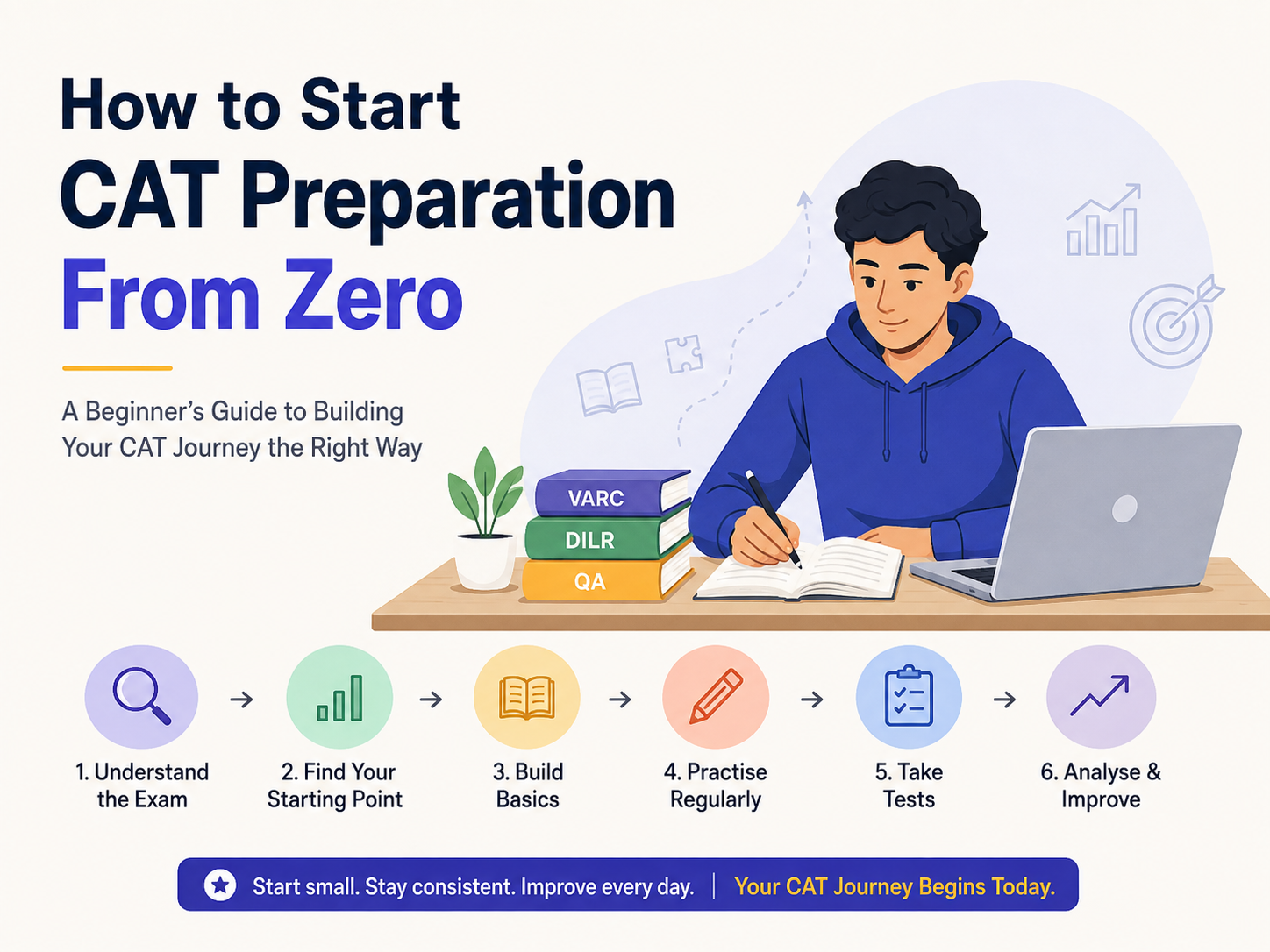
Understand CAT → Find your starting point → Build basics → Practise regularly → Take tests → Analyse mistakes → Improve
CATKing's beginner-focused preparation content follows a similar philosophy: understand what the examination tests before creating an unrealistic timetable, identify your current level and then build section-wise fundamentals.
This guide will explain exactly how to start CAT preparation from zero.
Phase 1: Understand What CAT Actually Tests
Before buying books, joining a course or creating a timetable, understand the examination.
CAT has three sections:
VARC — Verbal Ability and Reading Comprehension
This section tests your ability to read, understand, interpret, and analyze written information.
DILR — Data Interpretation and Logical Reasoning
This section tests how well you can understand information, identify patterns, and solve logical problems.
QA — Quantitative Ability
This section tests mathematical concepts and, more importantly, your ability to apply them to unfamiliar problems.
The first thing beginners need to understand is this:
CAT is not simply a syllabus-completion examination.
You cannot prepare effectively by memorising hundreds of formulas and hoping similar questions appear.
You need to develop:
-
Conceptual understanding
-
Logical thinking
-
Question selection
-
Time management
-
Accuracy
-
Problem-solving ability
CATKing's beginner guidance similarly describes CAT preparation as more than rote learning, with an emphasis on logical thinking, reading ability, mathematical application and decision-making under time pressure.
Phase 2: Find Out Where You Are Starting From
If you are beginning from zero, don't copy someone else's timetable.
First, understand your own starting point.
Ask yourself:
For QA
-
Am I comfortable with basic arithmetic?
-
Can I solve percentages and ratios?
-
Have I forgotten school mathematics?
-
Which topics make me uncomfortable?
For VARC
-
Do I read regularly?
-
Can I understand long articles?
-
Do I struggle with reading speed?
-
Do I often misunderstand what I read?
For DILR
-
Do I enjoy puzzles?
-
Can I organise information?
-
Do I get confused when a question contains too much data?
You don't need to be excellent at any of these on Day 1.
You simply need to know where you stand.
CATKing recommends that beginners start from their actual level rather than creating unrealistic plans based on where toppers are in their preparation journey.
Should You Take a Mock Test Before Starting CAT Preparation?
Yes, but don't judge yourself based on the score.
Your first mock or diagnostic test has one purpose:
To show you your starting point.
If your score is low, that is normal.
You have not started preparing yet.
Use the diagnostic test to identify:
-
Strong areas
-
Weak areas
-
Topics you recognise
-
Questions you cannot understand
-
Sections where you lose time
Don't spend three days worrying about your first mock score.
Instead, ask:
What does this test tell me about my preparation?
CATKing's preparation approach repeatedly treats tests and mocks as feedback tools: identify weak areas, practise them and test yourself again.
Phase 3: Start With the Basics
Once you understand your baseline, start building your fundamentals.
The biggest beginner mistake is opening an advanced CAT question bank immediately.
You see a difficult question.
You cannot solve it.
You feel that CAT is impossible.
That is the wrong way to begin.
Start with:
Basic Concepts → Easy Questions → Moderate Questions → CAT-Level Questions
CATKing's current learning ecosystem is similarly structured around concept-building material before moving into higher-level practice, PYQs and testing.
How to Start VARC Preparation From Zero
Many students believe that VARC preparation means learning thousands of English words.
It doesn't.
For beginners, the most important starting point is:
Start reading.
Read something every day.
You can begin with:
-
Editorials
-
Long-form articles
-
Opinion pieces
-
Business articles
-
Science articles
-
History and philosophy articles
-
Social science writing
The objective is not to finish ten articles in one day.
The objective is to understand what you read.
After reading an article, ask:
-
What was the main idea?
-
What was the author's argument?
-
What was the tone?
-
What was the conclusion?
-
Could I explain the article to someone else?
That habit will eventually help with Reading Comprehension.
CATKing's beginner guide specifically recommends daily reading and initially focusing on comprehension rather than speed. It also advises beginners to practise RC without immediately putting themselves under extreme time pressure.
A simple VARC routine for beginners
Daily
-
Read for 30–45 minutes.
-
Solve one RC or practise verbal questions.
-
Review why your answers were correct or incorrect.
Don't do this
-
Memorise random word lists for hours.
-
Ignore reading because you think your English is already good.
-
Start timing everything from Day 1.
Build comprehension first.
Speed will improve with practice.
How to Start DILR Preparation From Zero
DILR can initially look scary because every set appears different.
But that is exactly why you should not search for a single shortcut.
The best way to begin is to expose yourself to different kinds of logical problems.
Start with:
-
Simple arrangements
-
Tables
-
Distribution problems
-
Games and tournaments
-
Basic logical puzzles
-
Data interpretation sets
When solving a set, don't immediately look for the answer.
First ask:
What information do I have, and how can I organise it?
Use:
-
Tables
-
Diagrams
-
Cases
-
Visual arrangements
-
Elimination
CATKing's beginner material recommends starting with easier puzzles and understanding how information is arranged before moving towards timed CAT-level practice.
A simple DILR rule
At the beginning:
Focus on understanding.
Later:
Focus on speed.
You cannot develop speed in something you don't yet understand.
How to Start Quant Preparation From Zero
This is where many students panic.
Especially students who:
-
Are from a non-engineering background
-
Have not studied maths for years
-
Were weak at mathematics in school
The good news is that you do not have to begin with the most difficult CAT questions.
Start by rebuilding your basics.
A practical progression is:
Step 1: Arithmetic fundamentals
Start with topics such as:
-
Percentages
-
Ratios and proportions
-
Averages
-
Profit and loss
-
Simple and compound interest
-
Time and work
-
Time, speed and distance
Step 2: Move towards other important areas
Gradually build your understanding of:
-
Algebra
-
Number systems
-
Geometry
-
Modern mathematics topics relevant to your preparation
Don't rush through topics simply to say that you have “completed the syllabus.”
For every concept:
Learn → Understand → Solve basic questions → Practise → Review mistakes
The CATKing preparation framework emphasises foundational concept-building followed by progressively more challenging practice and actual CAT questions.
Phase 4: Study All Three Sections Together
One of the biggest mistakes beginners make is spending two months only on Quant because they feel weak in maths.
Then they suddenly realise:
“I haven't prepared VARC or DILR.”
CAT has three sections.
Your preparation should reflect that.
You don't need to study all three sections for six hours every day.
But all three should receive regular attention.
CATKing's preparation guidance recommends balanced exposure across Quant, DILR and VARC rather than focusing on one section for excessively long periods.
A Beginner-Friendly Daily CAT Study Plan
If you are starting from zero, a realistic schedule matters more than an ambitious one.
You can begin with approximately 2–3 focused hours a day and adjust according to your schedule and preparation level.
Example routine
Option A: Student
VARC: 45 minutes
QA: 60 minutes
DILR: 45 minutes
Reading: 20–30 minutes
Option B: Working professional
You may divide your preparation into smaller sessions:
Morning: Reading or VARC
Evening: QA concepts and questions
Alternate days: DILR practice
Weekend: Revision, sectional tests and longer practice sessions
The best timetable is not the one that looks impressive.
It is the one you can follow consistently.
Phase 5: Build a 90-Day Foundation
If you are starting from zero and have several months available, your first few months should be about building a strong base.
Month 1: Understand and Build
Focus on:
-
Understanding CAT
-
Identifying your strengths and weaknesses
-
Building reading habits
-
Revising mathematical basics
-
Solving easy DILR sets
Don't obsess over percentile yet.
Month 2: Practise and Apply
Focus on:
-
More topic-wise questions
-
RC practice
-
Different DILR set types
-
Moderate-level Quant questions
-
Initial sectional tests
Month 3: Start Testing Yourself
Focus on:
-
Timed practice
-
Sectional tests
-
Regular revision
-
Mock introduction
-
Detailed analysis
The exact duration will depend on when you start preparing, but the progression remains useful:
Understand → Learn → Practise → Test → Analyse
Phase 6: Start Using CAT Previous-Year Questions
Previous-year questions are important because they help you understand the actual level and style of CAT.
But don't make PYQs your only resource from Day 1.
First build enough understanding to learn from them.
Then use them to identify:
-
Frequently tested concepts
-
Question difficulty
-
Different ways concepts are applied
-
Your current performance level
CATKing's preparation resources include actual CAT PYQs from recent examination years as part of the progression from concepts to real CAT-level practice.
Phase 7: Start Mocks, But Don't Worship Your Score
A mock test is not your CAT result.
It is preparation.
The most important thing after a mock is not:
“What percentile did I get?”
It is:
“Why did I get that result?”
After every mock, analyse:
Questions I got wrong
Was it a:
-
Concept problem?
-
Calculation mistake?
-
Reading mistake?
-
Logical error?
Questions I didn't attempt
Did I:
-
Fail to understand them?
-
Run out of time?
-
Miss an easy question?
-
Get stuck on a difficult question?
Questions I attempted correctly
Can I solve similar questions consistently?
CATKing's testing ecosystem includes topic-wise tests, sectional tests, sprint tests, proctored mocks and actual CAT papers, reflecting the idea that testing should gradually become more comprehensive as preparation develops.
The Most Important Skill in CAT: Learning From Mistakes
Your preparation will improve much faster if you maintain an error log.
After every practice session or test, note:
| Mistake | Why It Happened | What to Do |
|---|---|---|
| Forgot concept | Weak fundamentals | Revise |
| Calculation error | Rushed solution | Slow down and verify |
| Took too long | Wrong approach | Learn alternative methods |
| Didn't understand question | Weak interpretation | Practise similar questions |
| Chose a difficult question | Poor selection | Improve question choice |
This turns preparation into a feedback loop:
Test → Analyse → Identify → Improve → Test Again
Can a Non-Maths Student Start CAT Preparation From Zero?
Yes.
Your academic background can affect your starting point, but it does not decide your final CAT percentile.
If you haven't studied mathematics recently, you may need more time to rebuild fundamentals.
That doesn't mean CAT is closed to you.
Start from the basics.
Don't compare your first week of Quant preparation with someone who studied engineering mathematics for four years.
Focus on your own improvement.
Can I Prepare for CAT Without Coaching?
Yes.
Self-study can work if you have:
-
A structured plan
-
Reliable learning resources
-
Practice material
-
Mock tests
-
Discipline
-
A way to analyse your performance
CATKing's own beginner content acknowledges that CAT can be prepared for through self-study with proper planning and discipline. Its broader free and paid learning ecosystem is built around structured concept learning, practice resources, PYQs and testing.
Coaching can provide structure and guidance, but simply joining a course does not prepare you automatically.
You still have to:
-
Attend or watch the lessons.
-
Solve the questions.
-
Take the tests.
-
Analyse your mistakes.
How to Use YouTube, Instagram and Quora for CAT Preparation
A beginner today has access to an enormous amount of information.
That is useful, but it can also become a problem.
You may spend three hours watching:
-
CAT strategies
-
Toppers' interviews
-
College reviews
-
Preparation hacks
And complete zero actual questions.
Use different platforms for different purposes.
YouTube: Learn concepts and strategies
Use long-form videos for:
-
Understanding concepts
-
Learning approaches
-
Watching problem solutions
-
Understanding exam strategy
CATKing's YouTube-oriented content and learning resources are structured around foundational concepts, intermediate application and CAT-level problem-solving.
Instagram: Stay connected, not distracted
Use short-form content for:
-
Quick reminders
-
Preparation motivation
-
Important updates
-
Strategy tips
But don't confuse a 30-second CAT reel with actual preparation.
Quora: Understand real aspirant questions
Use discussions to explore:
-
Common preparation doubts
-
Different strategies
-
Student experiences
-
College and career questions
But remember:
An answer on the internet is not automatically correct simply because it sounds confident.
For important information, verify official sources and compare different perspectives.
The 7 Biggest Mistakes Beginners Make
Mistake 1: Waiting for the perfect time
You don't need a perfect Monday to begin.
Start today.
Mistake 2: Collecting too much material
One structured set of resources is better than ten unfinished books.
Mistake 3: Only watching lectures
Watching is not the same as solving.
Mistake 4: Ignoring your weakest section
Don't avoid a section for months because it makes you uncomfortable.
Mistake 5: Taking mocks without analysis
A mock without analysis is incomplete preparation.
Mistake 6: Comparing yourself with toppers
A topper's strategy may not match your starting point.
Mistake 7: Thinking low initial scores mean failure
Your first few tests are supposed to reveal weaknesses.
That is how you improve.
Your First 30 Days of CAT Preparation From Zero
If you are completely confused about where to begin, follow this simple framework.
Week 1: Understand Yourself
-
Understand the CAT structure.
-
Try questions from all three sections.
-
Identify strengths and weaknesses.
-
Start daily reading.
Week 2: Build Basics
-
Start Arithmetic fundamentals.
-
Solve basic RCs.
-
Solve easy DILR sets.
-
Begin maintaining an error notebook.
Week 3: Increase Practice
-
Solve more topic-wise questions.
-
Read consistently.
-
Try new DILR set types.
-
Begin moderate-level questions.
Week 4: Review and Test
-
Take a sectional or diagnostic test.
-
Analyse mistakes.
-
Identify weak areas.
-
Plan the next month.
At the end of 30 days, you don't need to know everything.
You need to have something more valuable:
A clear understanding of what you need to do next.
CATKing's Beginner Preparation Framework
The recurring approach across CATKing's accessible beginner and preparation content can be simplified into six stages:
1. Understand the examination
Know what CAT actually tests.
2. Identify your starting point
Don't prepare according to someone else's strengths.
3. Build concepts
Strengthen your fundamentals.
4. Practise consistently
Move from basic questions to CAT-level problems.
5. Test yourself
Use sectionals and mocks to measure progress.
6. Analyse and improve
Use every mistake to improve the next attempt.
CATKing's current preparation resources reflect this full progression through concept-builder lessons, topic tests, sectionals, sprint tests, previous CAT papers and mock analysis.
Final Answer: How Should I Start CAT Preparation From Zero?
If you are starting from zero, don't begin by asking:
“What is the fastest way to complete the CAT syllabus?”
Start by asking:
“Where am I right now, and what is the next thing I need to improve?”
Then follow this process:
Understand CAT → Take a diagnostic test → Build basics → Prepare all three sections → Practise → Take tests → Analyse mistakes → Repeat
You don't have to become a CAT expert in one week.
You don't have to score 99 percentile in your first mock.
You don't have to copy a topper's timetable.
You simply need to start.
And once you start, focus on improving a little every day.
Because for a beginner, the most important day of CAT preparation is not the day you finish the syllabus.
It is the day you stop overthinking and actually begin.
Frequently Asked Questions
Can I crack CAT if I am starting from zero?
Yes. Your starting point does not determine your final result. A structured preparation plan, consistent practice, testing and analysis can help a beginner develop CAT-level skills over time.
Which section should I start first for CAT?
You should begin building all three sections together. VARC reading can start immediately, while QA fundamentals and basic DILR practice can develop alongside it.
How many hours should a beginner study for CAT?
The right number depends on your available time and current level. Beginners can start with a realistic, focused routine and increase their study time as preparation becomes more intensive.
Should I take a mock before starting CAT preparation?
A diagnostic test can help you identify your current strengths and weaknesses. Don't judge your future CAT performance based on your first score.
Can a weak maths student crack CAT?
Yes. A weak maths background may mean you need additional time to rebuild fundamentals, but it does not automatically prevent you from performing well.
Is coaching necessary for CAT?
No. Self-study can work with the right resources, discipline, practice and mock analysis. Coaching can provide additional structure and guidance.
How long does it take to prepare for CAT from zero?
The answer depends on your starting level and target percentile. CATKing's current guidance indicates that candidates with different academic backgrounds and preparation levels may need significantly different timelines, while beginners benefit from starting early and building gradually.
What should I do on my first day of CAT preparation?
Understand the CAT examination, try a few questions from VARC, DILR and QA, identify your current level and create a simple routine that you can actually follow.
<article>

  <header>
    <h1>How to Start CAT Preparation From Zero: A Complete Beginner's Guide</h1>

    <p class="quick-answer">
      Yes, you can start CAT preparation from zero. Begin by understanding
      the exam, identifying your current level, building fundamentals in
      VARC, DILR and QA, practising regularly and analysing your mistakes.
    </p>
  </header>

  <section>
    <h2>Can I Start CAT Preparation From Zero?</h2>
    <!-- Direct answer first -->
  </section>

  <section>
    <h2>How Should a Beginner Start CAT Preparation?</h2>

    <ol>
      <li>Understand CAT</li>
      <li>Find your starting point</li>
      <li>Build fundamentals</li>
      <li>Practise consistently</li>
      <li>Take tests</li>
      <li>Analyse mistakes</li>
      <li>Improve and repeat</li>
    </ol>
  </section>

  <section>
    <h2>How to Prepare VARC From Zero</h2>
  </section>

  <section>
    <h2>How to Prepare DILR From Zero</h2>
  </section>

  <section>
    <h2>How to Prepare Quant From Zero</h2>
  </section>

  <section>
    <h2>Your First 30 Days of CAT Preparation</h2>
  </section>

  <section class="faq-section">
    <h2>Frequently Asked Questions</h2>

    <!-- Every FAQ question and answer should match the JSON-LD -->
  </section>

  <section class="final-answer">
    <h2>Final Answer: How Should I Start CAT Preparation From Zero?</h2>

    <p>
      Understand CAT → Take a diagnostic test → Build basics →
      Prepare all three sections → Practise → Take tests →
      Analyse mistakes → Repeat.
    </p>
  </section>

</article>