




4 months ago
Body
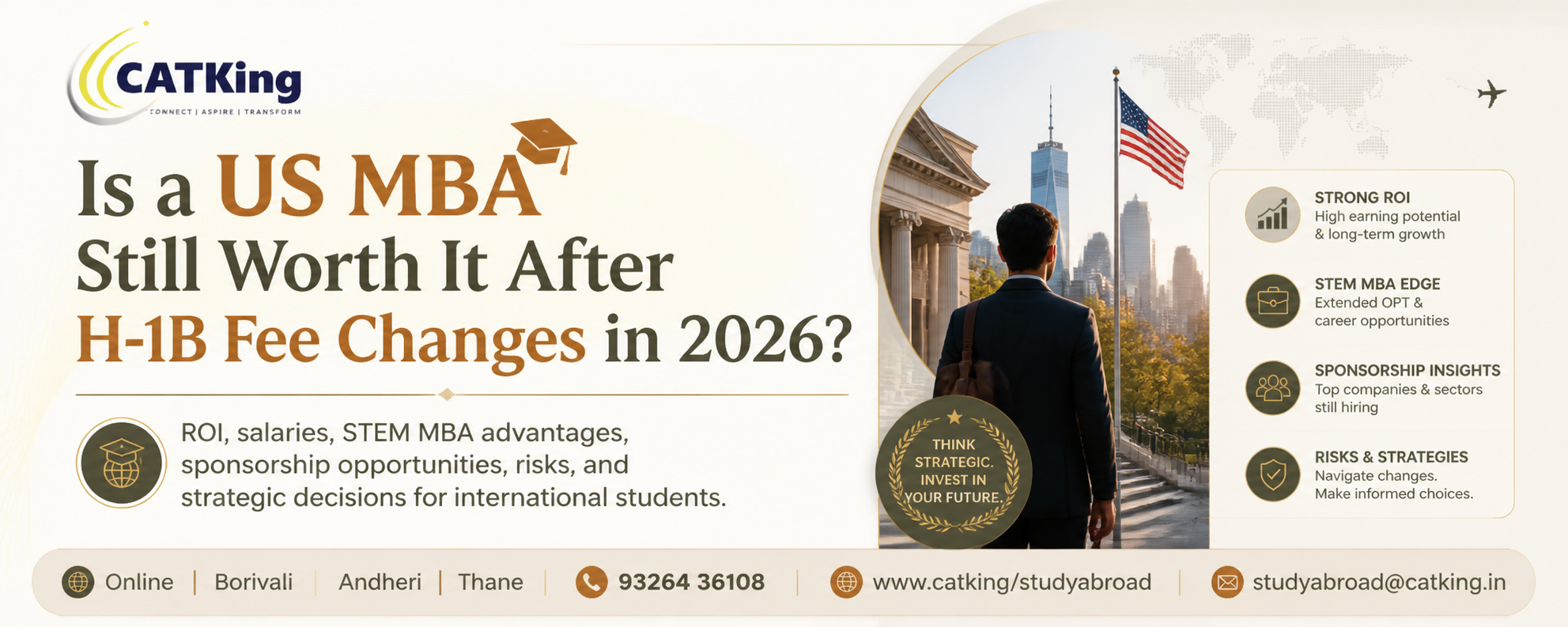
For years, a US MBA was considered one of the strongest pathways to a high-paying global career. Top salaries, elite business schools, global exposure, and access to companies like Google and Amazon made the US the dream destination for MBA aspirants.
But in 2026, things are no longer that simple.
With rising education costs, H-1B visa uncertainty, and changing hiring trends, students are now asking a more important question:
Is a US MBA still worth the investment?
The answer is yes, but only for students who approach it strategically.
What Is the H-1B Visa?
The H-1B is a US work visa that allows American companies to hire international professionals in specialized roles.
For MBA students, the journey usually looks like this:
-
Study in the US on an F-1 visa
-
Work after graduation through OPT
-
Employer files H-1B sponsorship
This is why H-1B discussions matter so much to international students planning to study in the US.
What Changed in 2026?
A lot of concern started after recent H-1B fee discussions.
The United States Citizenship and Immigration Services increased the H-1B registration fee from $10 to $215.
However:
-
Employers usually pay this fee
-
It mainly targets fake registrations
-
It does not directly make a US MBA unaffordable
Another major discussion involved reports of a possible $100,000 H-1B fee structure for some overseas petitions.
Should Students Panic?
Not really.
Most discussions were focused on companies hiring workers directly from outside the US, not necessarily students already studying there on F-1 visas.
The bigger reality is this:
A US MBA is no longer a guaranteed pathway to jobs and sponsorship. Students now need stronger profiles, better networking, and clearer career planning.
Why US MBA Outcomes Depend More on Strategy Now
Today, employers care about much more than just a degree.
Students who usually perform well after a US MBA have:
-
3 to 8 years of quality work experience
-
Strong communication skills
-
Clear career goals
-
Networking ability
-
Internship performance
-
STEM-designated MBA programs
STEM MBAs are especially valuable because they usually provide up to 36 months of work authorization instead of just 12 months.
That gives students more H-1B lottery attempts and more time to secure sponsorship.
Industries Still Sponsoring International MBAs
Some industries continue hiring international MBA graduates aggressively.
Consulting
Top consulting firms still sponsor many international MBA students.
Examples include:
-
McKinsey & Company
-
Boston Consulting Group
-
Bain & Company
Technology
Tech remains one of the strongest sectors for MBA graduates.
Companies include:
-
Microsoft
-
Google
-
Amazon
However, hiring has become more competitive compared to previous years.
Comparison Table
|
Factor |
Strong MBA Outcome |
Risky MBA Outcome |
|
University |
Top or reputed schools |
Low-ranked universities |
|
MBA Type |
STEM MBA |
Non-STEM MBA |
|
Work Experience |
3 to 8 years |
Very limited experience |
|
Career Goals |
Clear and focused |
Random or unclear |
|
Networking |
Active networking |
Placement-dependent |
|
Financial Planning |
Manageable debt |
Heavy education loans |
|
Target Industry |
Consulting, tech, finance |
Low-sponsorship sectors |
Salary / ROI Analysis
A top US MBA can cost the following:
-
$150,000 to $250,000+
-
Around ₹1.2 crore to ₹2 crore+ for Indian students
Average Post-MBA Salary Range
|
Industry |
Average Salary |
|
Consulting |
$140k to $190k |
|
Technology |
$120k to $170k |
|
Finance |
$150k+ |
|
Strategy & Leadership Roles |
$130k+ |
The ROI usually makes sense when students:
-
Secure strong post-MBA salaries
-
Enter sponsorship-friendly industries
-
Manage debt wisely
-
Build long-term global careers
Pros and Cons
Pros
-
High earning potential
-
Strong global network
-
Access to world-class companies
-
Excellent career growth opportunities
-
STEM MBA advantage for international students
Cons
-
Extremely expensive
-
H-1B sponsorship is not guaranteed
-
Competitive job market
-
High financial risk for weaker profiles
-
Immigration uncertainty
Who Should Choose This?
A US MBA still makes sense for students who:
-
Have strong work experience
-
Want careers in consulting, tech, or finance
-
Can handle competitive recruiting
-
Are targeting strong business schools
-
Understand immigration risks realistically
Students should reconsider if:
-
Their only goal is migration
-
They are taking unsustainable debt
-
They are choosing weak universities
-
They have no clear career strategy
FAQs
-
Is a US MBA still worth it in 2026?
Yes, but mainly for students with strong profiles, clear goals, and smart financial planning.
-
Is H-1B becoming impossible?
No. It is becoming more competitive and selective, but many international MBA graduates still secure sponsorship every year.
-
Why are STEM MBA programs important?
STEM MBAs usually offer up to 36 months of work authorization, giving students more H-1B lottery attempts.
-
Which industries sponsor international MBA students the most?
Consulting, technology, and finance remain some of the strongest sponsorship-friendly sectors.
-
What is the biggest mistake students make?
Assuming that a US MBA automatically guarantees a job and long-term settlement.
In conclusion, a US MBA is no longer the “easy pathway” it once seemed to be.
But for ambitious, skilled, and career-focused students, it still remains one of the most powerful career accelerators in the world.
The difference in 2026 is simple:
Success now belongs to students who plan strategically, understand the risks clearly, and make informed decisions instead of emotional ones.