


Explore what lies beyond your B-School journey. Hear from industry experts, alumni, and recruiters a...
4 months ago
Body
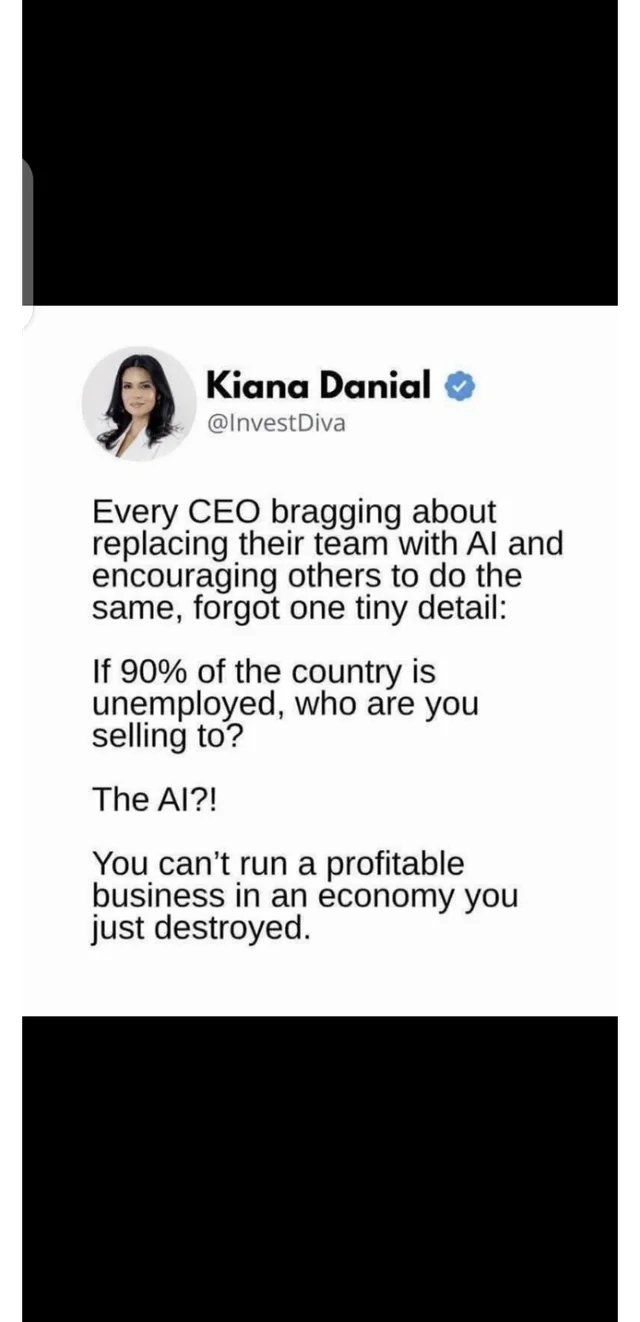
The debate over replacing headcount with AI often ignores the fundamental mechanics of a healthy market. If a CEO reduces their labor cost to near zero, they are optimizing for the P&L statement, but they are also unintentionally eroding the very customer base that fuels that P&L.
When we talk about automation, we need to shift our focus from "headcount reduction" to "value creation." The true risk isn't just that humans become redundant; it’s that our current economic model relies on humans earning wages to spend them back into the economy.
-
The Decoupling of Wages from Productivity: Historically, automation increased productivity, which eventually trickled down into higher wages and increased purchasing power. Current AI-driven automation risks decoupling this entirely. If companies hold onto the surplus value created by AI rather than reinvesting it into the labor market (through upskilling or new service roles), the system creates a "wealth vacuum" where money sits idle rather than circulating.
-
The Rise of High-Touch Human Economy: As AI commoditizes technical and routine cognitive tasks, value will shift towards "high-touch" human elements empathy, complex negotiation, high-level strategy, and community-based experiences. Businesses that fail to capitalize on these human-centric niches while automating the rest will likely face saturation as their automated products become indistinguishable from competitors.
-
The Necessity of Systemic Redistribution: For the economy to survive massive automation, the business community may eventually have to embrace models that look like corporate dividends or "automation taxes." If businesses want consumers to exist in the future, they have a vested interest in the financial stability of the population, even if that population isn't on their payroll.
Automation shouldn't be the final destination; it should be the lever that frees up human capital to move into higher-value services. A business that only measures success by "cost saved" is viewing the economy as a closed loop, when in reality, it is a living, breathing ecosystem of participants.
3 Replies
-
It’s a classic prisoner's dilemma. One company automating doesn't hurt the economy, but every company doing it simultaneously without a new model for distributing that wealth will inevitably collapse demand. We need business leaders who think in systems, not just quarterly margins
-
Exactly. The shift toward a high-touch human economy is the only way this works. We need to stop viewing AI as a replacement for the human element and start viewing it as an infrastructure layer that lets humans focus on the 'complex, empathetic' tasks machines can't touch
-
This is exactly why the focus on 'AI ROI' needs to change. If you aren't factoring in the long-term health of your consumer market, you aren't really 'ptimizing you're just harvesting the field until nothing grows back


