

Crack the CAT, together. Welcome to the ultimate prep zone for CAT aspirants. From 99 percentilers s...

4 months ago
Body
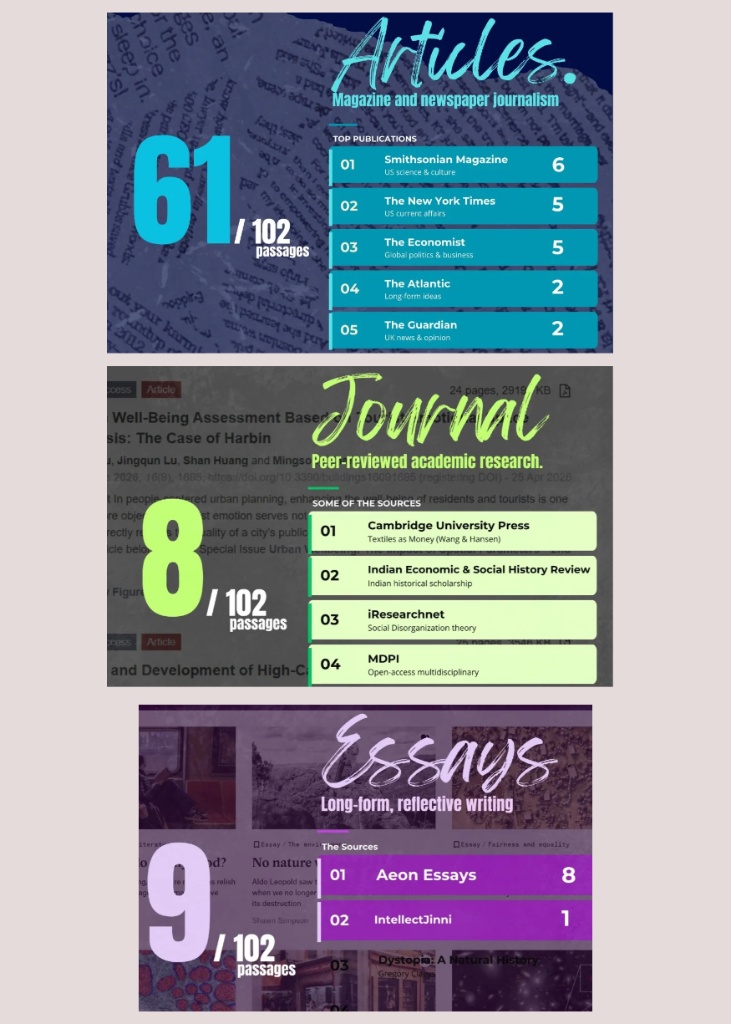
If you are blindly reading random novels or scroll-heavy news feeds hoping your VARC score will magically shoot up, you are wasting precious preparation time. The data from the last 5 years of CAT papers shows a very clear pattern of where the conveners pull their reading comprehension (RC) passages from:
-
Articles (61/102 Passages): The absolute king of CAT VARC. Primarily sourced from Aeon Essays, The New York Times, The Economist, and Smithsonian Magazine.
-
Essays & Journals (17/102 Passages): Academic, long-form, and heavily dense material from sources like Cambridge University Press and multidisciplinary research portals.
Simply "reading" these isn't enough. To crack the complex, inference-based questions CAT loves, you have to read intentionally. Here is your tactical blueprint:
1. How to Read Intentionally (Active Parsing)
Stop reading to finish the text; read to map the author’s mind.
-
After every single paragraph, pause for 3 seconds and mentally summarize it in exactly one sentence.
-
Track the pivots. Look for structural transition words like However, Albeit, Paradoxically, Consequently, Ironically. These words indicate exactly where the author is shifting their stance—which is precisely where CAT frames its questions.
2. How to Learn New Words Without Memorizing Dictionaries
Rote learning a thousand flashcards won't help when a word changes meaning based on context.
-
Contextual Guessing: When you hit an unfamiliar word in an Aeon essay, do not open Google instantly. Force yourself to guess its tone (positive, negative, or neutral) based on the surrounding sentences.
-
The Personal Log: Keep a digital notebook. Jot down the word, the exact sentence you found it in, and write one sentence of your own using it. Review this log once a week.
3. Scaling Up Your Stamina
CAT passages are dense, dry, and philosophically abstract.
-
Start with Articles (The NYT or The Guardian) for 30 minutes a day to build basic velocity.
-
Once comfortable, switch completely to Aeon Essays and The Economist. These long-form pieces train your brain to hold onto a complex argument for 1,500+ words without losing focus or skimming.
4 Replies
-
Saved this immediately. Most coaching institutes just throw sectional tests at you without telling you how to fix the root issue: poor reading stamina. Sourcing your daily reads from this exact list is the best way to train your brain.
-
If you read just 2 essays from Aeon and 1 article from The Economist every single day starting now, your familiarity with complex sentence structures will double by November. Consistency beats brute-forcing a week before the exam.
-
Huge tip on contextual guessing. Half the time, the options in CAT check if you understand the nuance of a word within the passage, not its literal dictionary definition. Building a personal context log is a game-changer.
-
Seeing Aeon and Smithsonian dominate the metrics makes total sense. CAT doesn't test your speed-reading; it tests your comfort with unfamiliar, dry topics like evolutionary biology or 18th-century art history. Get used to being bored while reading!


