





Crack the CAT, together. Welcome to the ultimate prep zone for CAT aspirants. From 99 percentilers s...

4 days ago
Body
In the modern CAT or XAT environment, the examiners aren't testing your ability to use d = s (×) t; they are testing your ability to visualize dynamic movement.
1. The "Starting Gap" Trap (Relative Speed)
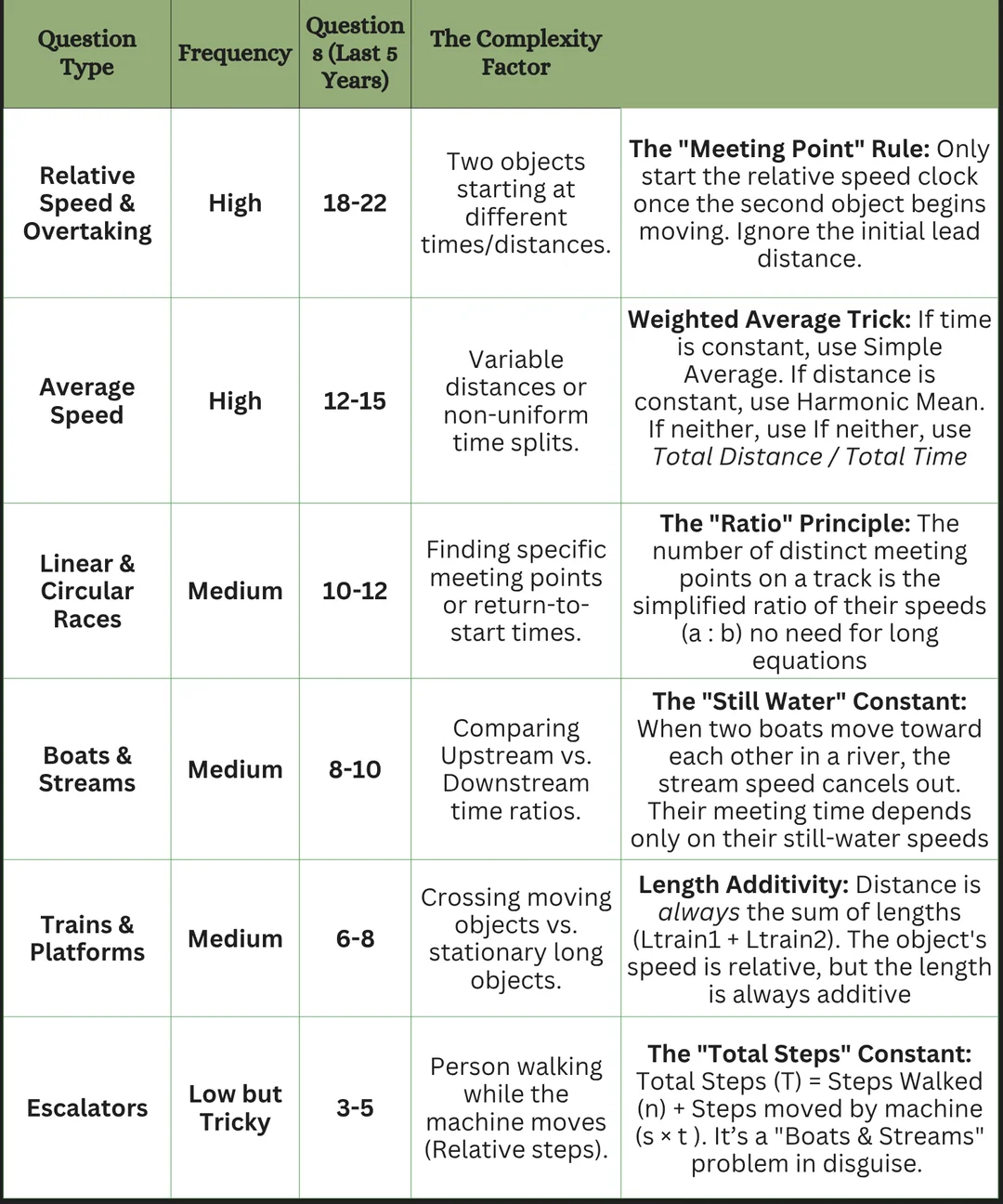
Most students fail Relative Speed problems because they apply the formula while one object is still stationary. The "Meeting Point" Rule is the ultimate filter: you must calculate the "lead distance" covered by the first object and only then "start the clock" for both. This reduces a 5-step algebra problem into a 1-step division.
2. The Geometric Logic of Circular Races
Instead of solving for time T, the Ratio Principle (a:b) allows you to determine the number of distinct meeting points instantly.
-
If moving in the same direction: |a - b| points.
-
If moving in opposite directions: a + bpoints.
This is a massive time-saver for Data Interpretation (DI) sets that involve track movements.
3. Escalators: The Modern "Boats & Streams"
The table correctly identifies Escalators as "Boats & Streams in disguise." The "Stream" is the escalator's speed, and the "Boat" is the person's walking speed. The Total Steps Constant is the most reliable way to solve these without getting tangled in variable time-frames.
3 Replies
-
The 'Length Additivity' rule for Trains and Platforms is the most common place for 'silly mistakes.' Remember: Length is always added, but Speed is relative. I’ve seen so many students subtract lengths when trains move in the same direction—don't be that person. Keep the logic of 'Total Distance to be covered' clear in your head
-
The 'Still Water Constant' mentioned in the Boats & Streams section is a game-changer for 'Meeting' problems. Most people try to add/subtract the stream speed for both boats, but since one is going upstream and one is downstream, the $\pm v$ cancels out. It simplifies the entire problem to a basic relative speed task in still water. Don't overcomplicate the physics
-
Notice that 'Average Speed' has a higher frequency (12-15) than 'Trains' (6-8). Aspirants often spend days memorizing train lengths, but the real marks are in the Weighted Average/Harmonic Mean shortcuts.


