




3 months ago
Body
For students planning to study abroad, the UK continues to remain one of the most attractive destinations because of its globally respected universities, shorter master’s programs, and post-study work opportunities.
However, in 2026, one major concern dominates discussions among students and parents:
“Will the UK still allow international students to stay and work after graduation?”
The answer, as of now, is yes.
The UK Graduate Route, commonly known as the 2-year post-study work visa, is still active for eligible international students. But recent immigration discussions and policy reviews have created uncertainty and confusion.
As a study abroad consultant with over 20 years of experience helping students with admissions, scholarships, visas, education loans, and international careers, I believe students need clarity instead of panic.
This blog explains the complete reality behind the UK Graduate Route in 2026, including:
-
Whether the visa is safe
-
What changes may happen
-
Job opportunities after graduation
-
Salary and ROI expectations
-
Sponsorship realities
-
Which students benefit the most from the UK
What Is the UK Graduate Route?
The UK Graduate Route is a post-study work visa introduced in 2021 that allows international students to stay and work in the UK after completing their degree.
This visa gives students the flexibility to:
-
Work full-time
-
Search for jobs
-
Gain international work experience
-
Switch employers freely
-
Build long-term career opportunities
without immediately needing employer sponsorship.
Duration of the Graduate Route
|
Degree Level |
Duration |
|
Bachelor’s Degree |
2 Years |
|
Master’s Degree |
2 Years |
|
PhD |
3 Years |
This is why students often call it the “2-year UK work visa.”
Is the Graduate Route Still Active in 2026?
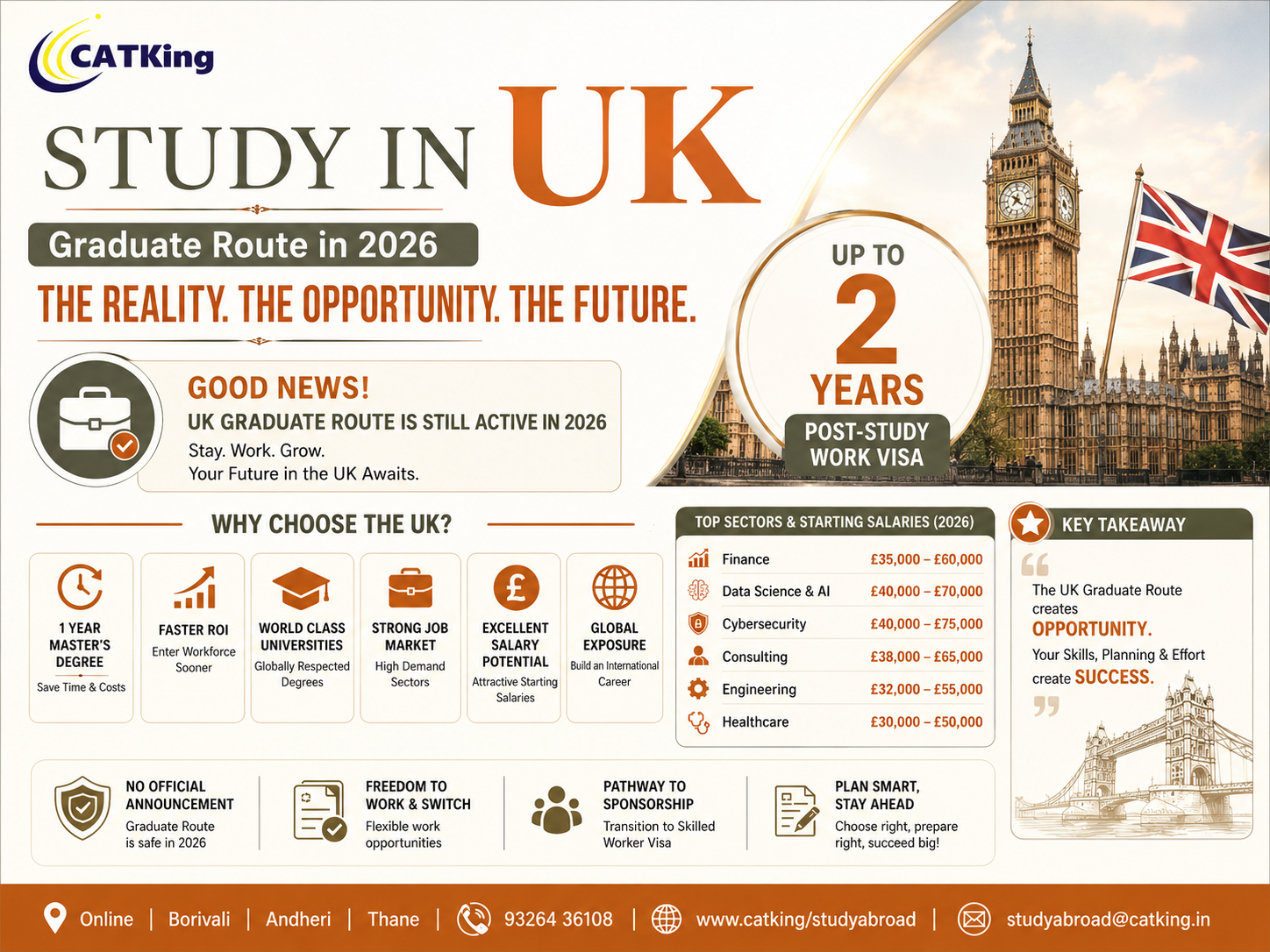
Yes, the UK Graduate Route is still active in 2026.
There has been no official announcement removing the Graduate Route for eligible international students.
Students graduating from approved UK universities can still apply for this post-study work visa.
However, students should understand the difference between:
-
Political discussions
and -
Actual immigration policy implementation
Immigration policies are often debated publicly before any real changes happen.
At present, the UK continues to support international students because they contribute significantly to:
-
University revenues
-
Skilled workforce requirements
-
Research ecosystems
-
Economic growth
Why Are Students Worried About UK Visa Changes?
The concern mainly started because the UK government has been trying to reduce overall migration numbers.
This led to several immigration-related discussions and policy changes, such as:
-
Restrictions on dependents for many taught master’s students
-
Increased scrutiny of certain institutions
-
Reviews of graduate visa misuse
-
Discussions around tightening immigration pathways
As a result, many students started worrying about:
-
Cancellation of the Graduate Route
-
Reduced visa duration
-
Fewer sponsorship opportunities
-
Difficult job markets
While these concerns are understandable, students should avoid relying solely on social media panic and focus on verified information.
Why the UK Still Needs International Students
International students remain extremely important for the UK economy and education system.
They contribute through:
-
Tuition fees
-
Local spending
-
Skilled talent supply
-
Workforce participation
-
Innovation and research
UK universities also strongly support the Graduate Route because it helps attract global talent.
If the UK becomes too restrictive, it risks losing students to countries like:
-
Canada
-
Australia
-
United States
which are also aggressively competing for international students.
Could the Rules Become Stricter in the Future?
Possibly, yes.
Students should remain realistic.
Some areas that could see tighter regulations include:
-
Minimum salary thresholds
-
University compliance checks
-
Skilled worker transition rules
-
Crackdowns on low-quality institutions
However, governments usually provide:
-
Transition periods
-
Advance notice
-
Protection for existing students
This means current students are often less affected than future applicants.
Important Reality About Jobs and Sponsorship
One of the biggest misconceptions students have is
“The Graduate Route guarantees a job.”
That is incorrect.
The Graduate Route only gives students legal permission to stay and work in the UK temporarily.
Actual job success depends on:
-
University reputation
-
Skills and technical knowledge
-
Internship experience
-
Communication abilities
-
Networking efforts
-
Market demand
What Is Sponsorship?
After the Graduate Route period ends, many students aim to transition into the Skilled Worker Visa.
A sponsored job means:
A UK employer officially supports your long-term work visa application.
To sponsor international employees, companies must:
-
Hold a sponsorship license
-
Offer eligible skilled jobs
-
Meet salary requirements
Generally, larger employers are more open to sponsorship than smaller firms.
Advantages of Studying in the UK
1. Shorter Degree Duration
Most UK master’s programs are only 1 year long.
This helps reduce:
-
Tuition costs
-
Living expenses
-
Opportunity cost
compared to countries with 2-year master’s programs.
2. Faster Entry Into the Workforce
Students can begin earning sooner after graduation, which helps with:
-
Loan repayment
-
Career growth
-
Financial planning
3. Globally Respected Universities
The UK is home to prestigious institutions such as:
-
University of Oxford
-
University of Cambridge
-
Imperial College London
-
University College London
4. Strong Career Opportunities
The UK job market remains strong in sectors like:
-
Finance
-
AI & Data Science
-
Cybersecurity
-
Consulting
-
Healthcare
-
Business Analytics
-
Engineering
-
FinTech
Cities like London continue to remain global hiring hubs.
Comparison Table
|
Factor |
UK |
Canada |
Australia |
USA |
|
Master’s Duration |
1 Year |
1–2 Years |
1.5–2 Years |
2 Years |
|
Post-Study Work Visa |
2 Years |
Up to 3 Years |
2–4 Years |
OPT/STEM OPT |
|
Tuition Cost |
Medium-High |
Medium |
Medium-High |
High |
|
Living Costs |
High in London |
Medium |
High |
High |
|
PR Pathway |
Moderate |
Strong |
Strong |
Complex |
|
ROI Speed |
Fast |
Moderate |
Moderate |
Depends on Job |
|
Global Brand Value |
Very Strong |
Strong |
Strong |
Extremely Strong |
Salary / ROI Analysis
Average Starting Salaries in the UK (2026)
|
Sector |
Estimated Starting Salary |
|
Finance |
£35,000 – £60,000 |
|
Data Science & AI |
£40,000 – £70,000 |
|
Consulting |
£38,000 – £65,000 |
|
Engineering |
£32,000 – £55,000 |
|
Cybersecurity |
£40,000 – £75,000 |
|
Healthcare |
£30,000 – £50,000 |
Why ROI Can Be Attractive in the UK
The UK often provides faster ROI because:
-
Most master’s degrees are only 1 year
-
Students enter the workforce earlier
-
Living expenses are reduced compared to longer programs
-
International work experience improves future salary potential
However, ROI depends heavily on:
-
University quality
-
Student skills
-
Networking
-
Internship exposure
-
Industry demand
Pros and Cons
Pros
-
Shorter master’s programs
-
Faster ROI
-
Globally respected universities
-
Strong post-study work opportunities
-
Excellent exposure to international markets
-
Strong industries in finance, AI, consulting, and tech
Cons
-
Competitive job market
-
High living costs in cities like London
-
Sponsorship is not guaranteed
-
Immigration rules can evolve
-
Lower-ranked universities may provide weak outcomes
Who Should Choose This?
The UK is usually a strong option for students who:
-
Want faster ROI
-
Prefer shorter courses
-
Have clear career goals
-
Can actively network
-
Want international work exposure
-
Are comfortable with competitive hiring environments
Students Who Should Be More Careful
Students should rethink their strategy if they:
-
Choose random low-ranked colleges
-
Expect guaranteed jobs
-
Have no financial backup
-
Select low-demand courses
-
Avoid networking and communication-building
The UK rewards proactive students much more than passive ones.
FAQs
Is the UK Graduate Route still available in 2026?
Yes. The Graduate Route remains active for eligible international students in 2026.
Is the UK cancelling the 2-year work visa?
No official announcement has cancelled the Graduate Route as of now.
Does the Graduate Route guarantee sponsorship?
No. The Graduate Route only gives legal permission to stay and work temporarily. Sponsorship depends on employers and job eligibility.
Which sectors are strongest in the UK for international students?
Finance, AI & Data Science, Cybersecurity, Consulting, Healthcare, Business Analytics, and Engineering remain strong sectors.
Is the UK still worth it for Indian students?
Yes, especially for students looking for faster ROI, globally respected education, and international career exposure.
In conclusion, the UK Graduate Route remains one of the strongest advantages for international students considering the UK in 2026.
But students must approach the UK strategically—not emotionally.
The reality is simple:
The visa creates opportunity, but it does not guarantee success.
Students who succeed internationally are usually the ones who:
-
Choose strong universities
-
Build employable skills
-
Gain internships
-
Network actively
-
Understand long-term visa pathways
The UK still offers excellent career potential for students who plan carefully and make informed decisions before applying.