


This is the heart of the forum—where offbeat thoughts, campus memes, random rants, success stories,...

1 day ago
Body
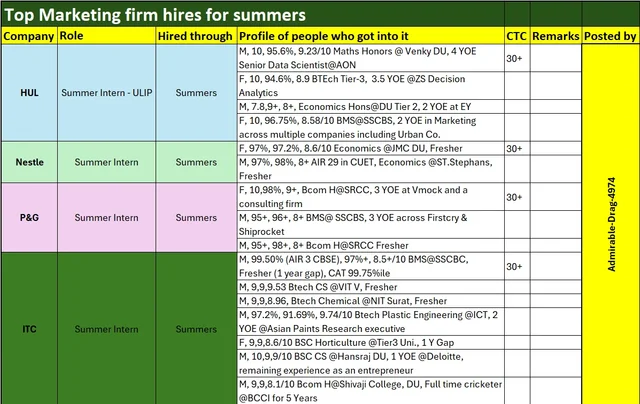
The recruitment blueprints for premier Fast-Moving Consumer Goods (FMCG) giants like Hindustan Unilever (HUL), Procter & Gamble (P&G), and Nestlé reveal a highly meticulous selection matrix. Landing a summer internship at these firms during an MBA is rarely the result of a single stellar metric. Instead, it requires a carefully balanced alignment of academic consistency, brand equity in undergraduate pedigree, and precise corporate storytelling.
The entry criteria for these coveted roles generally hinge on three distinct structural pillars:
-
The Academic Consistency Threshold: FMCG recruiters heavily index on past academic performance, often looking for a flawless "9/9/8" or "9/9/9" profile across Class 10, Class 12, and Graduation. Exceptional spikes, such as a near-perfect GPA or an All India Rank (AIR) in national boards or entrance exams, act as immediate differentiators in dense talent pools.
-
The Power of Institutional Pedigree: There is a pronounced preference for premium undergraduate colleges. Elite institutions across commerce, economics, and engineering—such as SRCC, St. Stephen's, SSCBS, IITs, and top-tier NITs—frequently populate the shortlist, as recruiters trust the rigorous filtering processes of these benchmark campuses.
-
High-Impact Pre-MBA Trajectories: Work experience is heavily scrutinized for quality over sheer quantity. Rather than generic roles, successful candidates often bring a background in data science, tier-1 consulting, or fast-paced startup operations (e.g., ZS, EY, Urban Company), demonstrating an immediate readiness to handle high-stakes corporate portfolios.
For freshers or those coming from non-traditional academic backgrounds, breaking into this tier requires an extraordinary individual spike. This can manifest as an exceptional national-level achievement outside of academics—such as representing official sports bodies like the BCCI—or demonstrating deep domain technical expertise, such as niche research publications or specialized corporate entrepreneurship. Ultimately, the modern FMCG selection process values structured analytical thinking paired with the agility to navigate complex consumer markets from day one.
4 Replies
-
It's incredibly reassuring to see the occasional non-traditional profile break through like the cricketer or the horticulture graduate. It shows that if your story is unique enough and backed by genuine excellence, the elite firms will look past the standard template.
-
The work experience quality is the real takeaway here. They aren't just hiring people with corporate tenure; they are specifically poaching analytical minds from firms like ZS and AON who can immediately decode complex consumer data.
-
Notice how heavy the DU North Campus and SSCBS bias is here. FMCG firms clearly prefer candidates who have already survived a hyper-competitive ecosystem before they even stepped into a business school.
-
This proves that the "9/9/9" profile rule isn't a myth for marketing roles. If your past academics are weak, you genuinely need an insane national-level spike or top-tier startup experience just to get your resume past the initial automated screening.


