



This is the heart of the forum—where offbeat thoughts, campus memes, random rants, success stories,...

6 months ago
Body
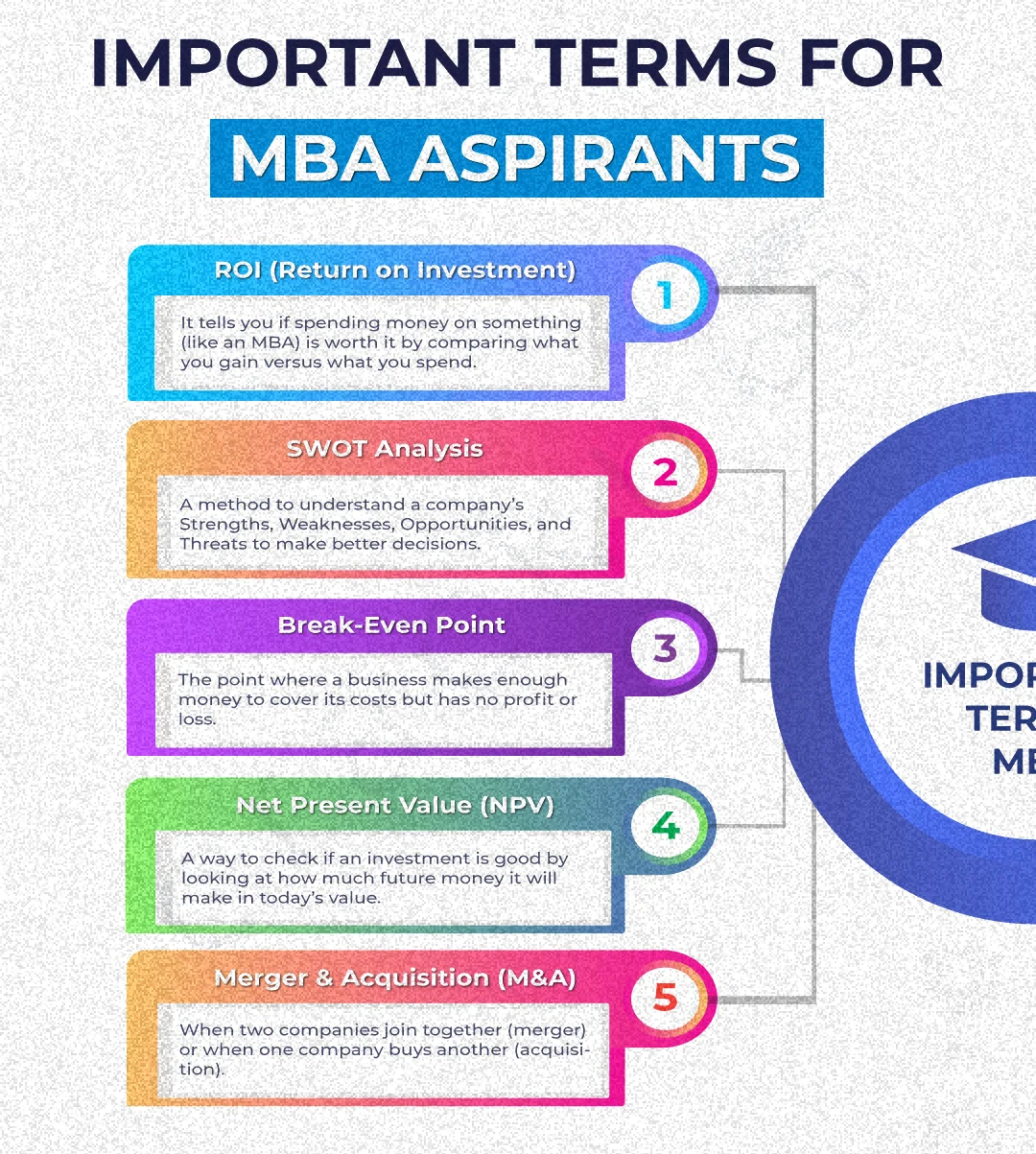
1. ROI (Return on Investment)
The ultimate measure of efficiency. It calculates the benefit an investor receives in relation to their investment cost.
-
The "Geek" Formula: $\text{ROI} = \frac{\text{Net Profit}}{\text{Cost of Investment}} \times 100$
-
Context: If you spend ₹25 Lakhs on an MBA and your salary increases by ₹15 Lakhs per year, your ROI is calculated by how quickly that "gain" covers the "cost."
2. SWOT Analysis
A strategic planning tool used to identify Strengths, Weaknesses, Opportunities, and Threats.
-
Application: Strengths and Weaknesses are internal (brand, tech), while Opportunities and Threats are external (market trends, new laws).
3. Break-Even Point (BEP)
The specific point where total revenue equals total costs. At this stage, a company is making zero profit but is no longer losing money.
-
Context: In "Quick Commerce" (Zepto/Blinkit), reaching the break-even point at a "dark store" level is the first sign of a sustainable business.
4. Net Present Value (NPV)
A financial metric used to determine the value of an investment today based on the money it will make in the future, adjusted for inflation and risk.
-
The Rule: If NPV is positive, the project is worth doing.
5. Merger & Acquisition (M&A)
-
Merger: Two companies of similar size join to form a new entity (e.g., Vistara and Air India).
-
Acquisition: A larger company buys a smaller one (e.g., Zomato buying Blinkit).
-
Key Goal: Synergy—the idea that the combined company is more valuable than the two separate parts.
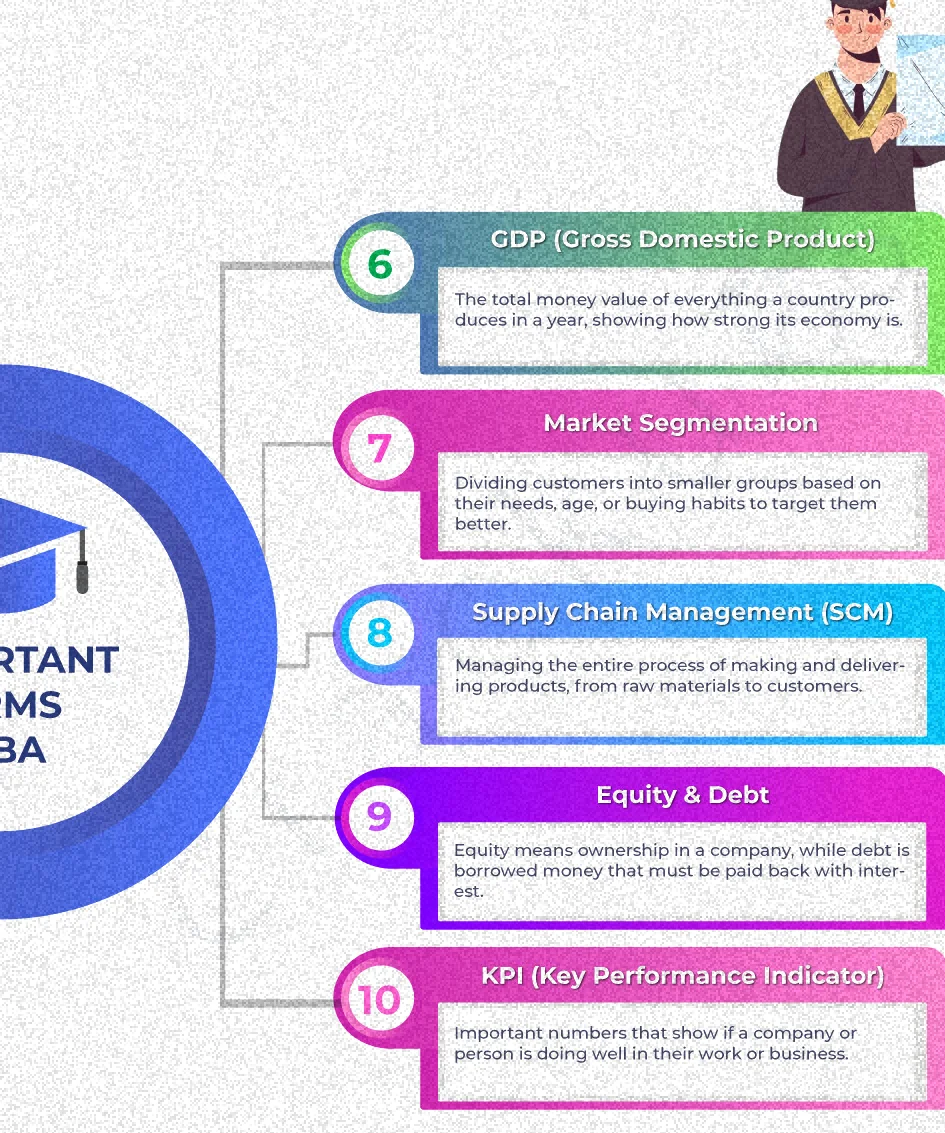
6. GDP (Gross Domestic Product)
The total monetary value of all finished goods and services produced within a country's borders in a specific time period. It is the "health report card" of an economy.
7. Market Segmentation
The process of dividing a broad consumer or business market into sub-groups based on shared characteristics (age, income, habits).
-
Example: Marriott owns Ritz-Carlton (Luxury segment) and Courtyard (Mid-scale segment) to target different "slices" of the market.
8. Supply Chain Management (SCM)
The active management of supply chain activities to maximize customer value and achieve a sustainable competitive advantage. It covers everything from sourcing raw materials to final delivery.
9. Equity & Debt
The two ways a company raises money:
-
Equity: Selling a piece of the company (ownership) to investors.
-
Debt: Borrowing money that must be paid back with interest (like a bank loan).
10. KPI (Key Performance Indicator)
A quantifiable measure used to evaluate the success of an organization or an employee in meeting objectives for performance.
-
Example: For an e-commerce site, a major KPI is the "Conversion Rate" (the percentage of visitors who actually buy something).
2 Replies
-
Supply Chain (SCM) is no longer a 'back-office' function. With global disruptions, SCM is now a 'Competitive Advantage.' Look at how Zara uses a lightning-fast supply chain to get new designs in stores in 2 weeks while others take 6 months. That's the power of SCM.
-
Don't confuse ROI with NPV. ROI is a quick snapshot of efficiency, but NPV is what you use for long-term multi-year projects. If you're discussing a 10-year infrastructure project in an interview, use NPV to show you understand the 'Time Value of Money

