



Ace the toughest MBA exam with the power of community. Tackle decision-making dilemmas, conquer essa...

6 hours ago
Body
XAT Grammar Rules You Cannot Ignore
If you’ve ever looked at a XAT Verbal Ability question and thought,
“Both options sound fine… why is my answer wrong?”,
you are not alone.
This confusion is one of the biggest reasons students underperform in XAT English, even when their overall verbal skills are decent.
The core problem is simple:
XAT does not reward what sounds right.
XAT rewards what is structurally correct.
Let’s break down exactly where students go wrong, with examples you’ll actually see in XAT.
1. The “Sounds Natural” Trap in XAT Grammar
Most students prepare English by reading articles, watching videos, or consuming content in everyday English. That works for comprehension, but it backfires in XAT grammar questions.
Why?
Because spoken English allows flexibility.
XAT grammar does not.
XAT follows formal written English rules, and it expects precision.
So when students rely on instinct instead of rules, they choose options that feel natural but are technically incorrect.
2. The Biggest XAT Grammar Killer: Negative Construction Misuse
This is one of the most repeatedly tested grammar concepts in XAT.
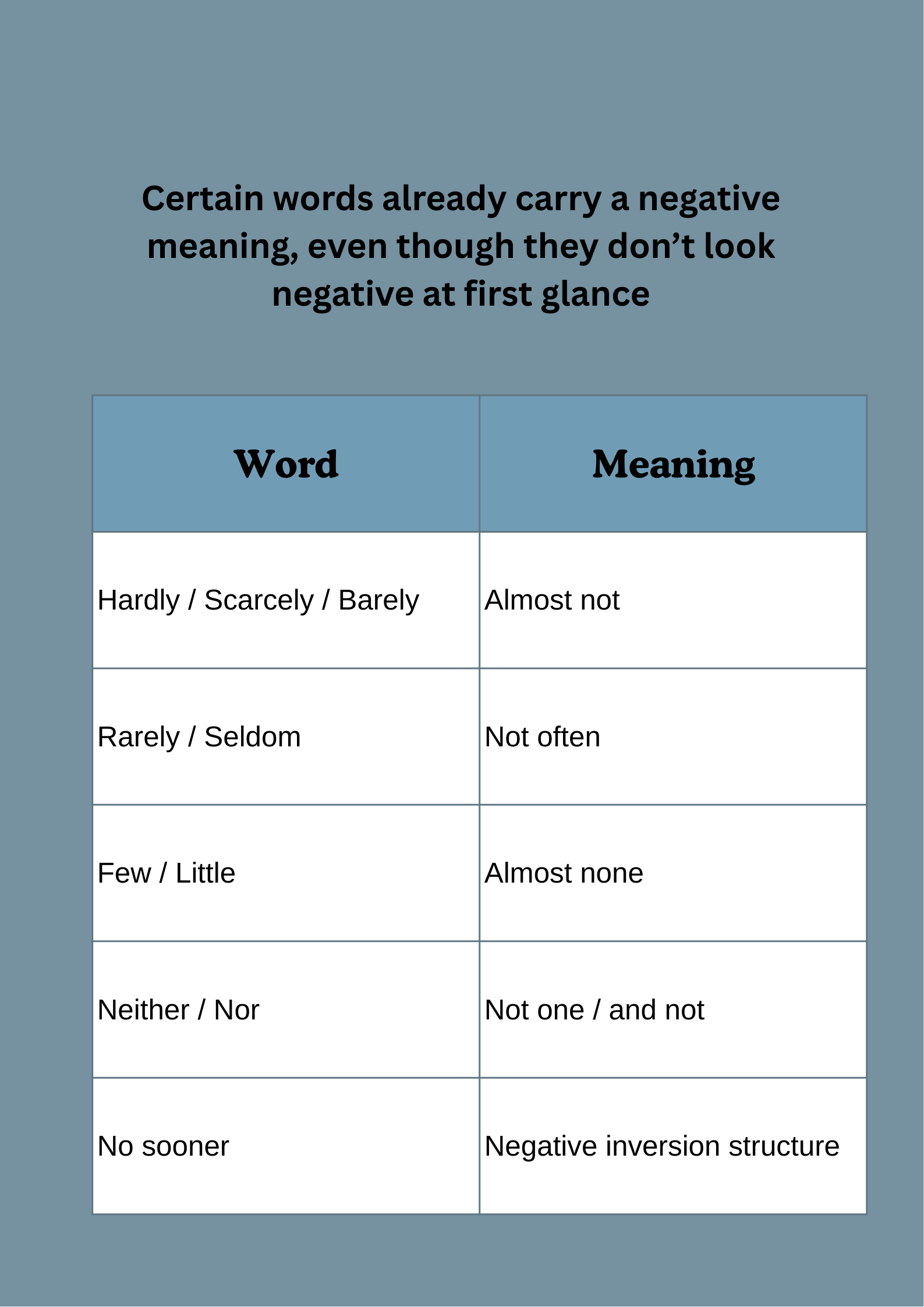
Certain words already carry a negative meaning, even though they don’t look negative.
Common examples:
-
Hardly
-
Scarcely
-
Barely
-
Rarely
-
Seldom
-
No sooner
These words already imply “not”.
Example 1 (XAT-style)
Incorrect:
He hardly did not understand the concept.
Why it’s wrong:
-
“Hardly” already means almost not
-
Adding “not” creates a double negative
Correct:
He hardly understood the concept.
This is where most students lose marks.
3. Why XAT Loves These Traps
XAT examiners know that:
-
Double negatives sound normal in spoken English
-
Students read fast and miss polarity
-
Options are designed to look equally meaningful
So they test whether you recognise structure over sound.
Example 2
Incorrect:
The manager scarcely didn’t react to the feedback.
Correct:
The manager scarcely reacted to the feedback.
The meaning barely changes in your head - but XAT grammar changes completely.
4. Inversion Confusion: When Correct Sentences Look “Wrong”
Another reason students eliminate correct options is inversion.
XAT frequently tests sentences that start with negative or restrictive words, which demand subject–auxiliary inversion.
Common XAT triggers:
-
No sooner
-
Hardly
-
Seldom
-
Rarely
Example 3
Correct (but looks odd):
No sooner had the meeting started than the argument broke out.
Incorrect (sounds normal):
No sooner the meeting started than the argument broke out.
Why students mess this up:
-
The correct sentence looks unfamiliar
-
The incorrect one sounds conversational
XAT does not care how it sounds.
XAT cares whether the auxiliary verb comes before the subject.
5. Hardly / No Sooner Structures You Must Memorize
These are non-negotiable XAT rules.
Correct Patterns:
-
Hardly had + subject + verb + when
-
No sooner had + subject + verb + than
Common XAT Trap:
No sooner did the interview start when the candidate panicked.
Why it’s wrong:
-
“Did” is unnecessary
-
“When” is incorrect with “no sooner”
Correct:
No sooner had the interview started than the candidate panicked.
If you don’t know this structure beforehand, you will guess — and guessing fails in XAT.
6. Grammar Hierarchy: How XAT Actually Wants You to Think
This is the most important mindset shift for XAT Verbal.
XAT grammar follows this hierarchy:
-
Structure
-
Grammar rules
-
Meaning
-
Sound
So if two options:
-
Mean the same thing
-
Sound equally acceptable
XAT will always choose the one that:
-
Obeys inversion rules
-
Avoids double negatives
-
Uses correct auxiliary placement
This is why students say:
“I understood the sentence, but still got it wrong.”
Understanding is not enough in XAT.
Rule awareness is compulsory.
XAT English is not about advanced vocabulary or flowery language.
It is about discipline in grammar.
Students who score well in XAT Verbal:
-
Trust rules over instinct
-
Recognise negative polarity instantly
-
Are comfortable with sentences that look unfamiliar
-
Eliminate options logically, not emotionally
Once you stop treating English as a “feel-based” subject and start treating it as a rule-based system, XAT grammar stops being scary and starts becoming predictable.